













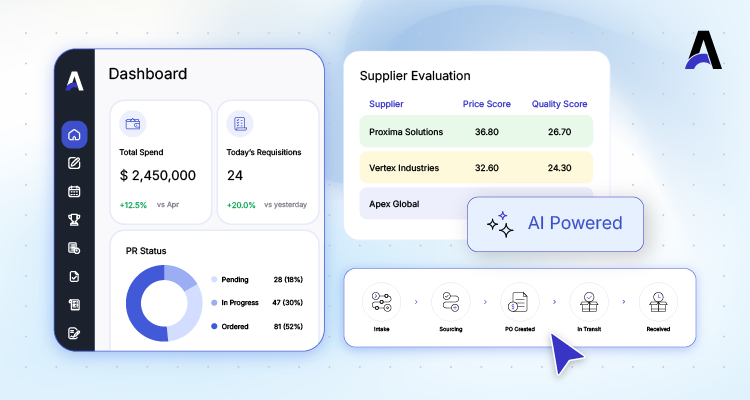
Cloud procurement software is a digital platform that enables organisations to manage sourcing, purchasing, suppliers, contracts and invoicing through cloud-hosted applications, typically delivered as Software as a Service (SaaS). Enterprises should evaluate cloud procurement platforms based on process coverage, ERP integration, security controls, configuration flexibility, supplier experience and total cost of ownership. This guide helps CIOs, CPOs and procurement leaders compare cloud-based procurement solutions, understand what security the vendor does and does not cover, and decide how a platform should sit alongside the ERP in a Source-to-Pay environment.
Key Takeaways
What Is Cloud Procurement Software?
Cloud procurement software is a set of procurement applications, such as intake, sourcing, purchasing, contracts and invoicing, that run on a provider's cloud infrastructure and are accessed over a network. The US National Institute of Standards and Technology defines cloud computing in its NIST SP 800-145 as "a model for enabling ubiquitous, convenient, on-demand network access to a shared pool of configurable computing resources." Most procurement platforms are sold as Software as a Service, or SaaS procurement software.
The terms SaaS, PaaS and IaaS describe what a buyer receives, not different kinds of procurement software. NIST describes them as follows:
| Service model | What the customer receives | Relevance to procurement buyers |
|---|---|---|
| SaaS | Provider applications accessed through a browser or program interface, with no management of the underlying infrastructure. | The usual model for cloud procurement platforms. |
| PaaS | A platform on which the customer deploys its own or acquired applications. | Relevant if you build custom procurement apps. |
| IaaS | Processing, storage and networking on which the customer runs its own software. | Relevant to IT teams hosting their own systems, not to buying a procurement platform. |
NIST also names four deployment models: private, community, public and hybrid cloud. Ask a vendor which applies to the environment that will hold your data.
How Does Cloud Compare With On-Premise and Hybrid Procurement Software?
Cloud procurement platforms usually deploy faster and receive updates from the vendor, while on-premise software gives more direct control over infrastructure at the price of more internal effort. Hybrid models combine both and are common where an on-premise ERP must connect to cloud applications.
| Criterion | Cloud (SaaS) | On-premise | Hybrid |
|---|---|---|---|
| Deployment effort | Vendor runs infrastructure; focus on configuration. | Customer installs and maintains infrastructure. | Mixed; depends on which parts are hosted where. |
| Updates | Vendor releases on its cycle. | Customer schedules and tests upgrades. | Varies by component. |
| Control and customisation | Configuration within vendor limits. | Deeper control, often with higher upkeep. | Control where you need it. |
| Cost pattern | Recurring subscription. | Upfront licence plus internal running cost. | Both elements. |
| Data location | Set by vendor hosting; must be verified. | In your own environment. | Split across environments. |
| ERP integration | Through connectors and APIs. | Direct network access to ERP. | Depends on design. |
What Are the Benefits of Cloud-Based Procurement Software?
The benefits of cloud-based procurement software come from how it is delivered, and each one holds only under certain conditions. Treat them as hypotheses to test in your evaluation.
- Faster start. The vendor already runs the infrastructure, so rollout can focus on process design, data and training rather than servers.
- Managed updates. New versions arrive from the vendor, which reduces upgrade projects. Check how releases are tested and communicated before they reach your users.
- Access across locations. Plants, entities and suppliers can use the same platform through a browser, which helps standardise process across sites.
- Scalability. Adding users, entities or suppliers is usually a configuration and licensing matter, not a hardware purchase.
- Integration through APIs. Modern platforms expose APIs and webhooks for ERP and other systems, which supports connected workflows.
- Common data view. A shared platform can provide one record of requests, sourcing events, contracts and orders, which improves visibility and auditability.
What Are the Limitations of Cloud Procurement Software?
Cloud procurement software has real limits that a buyer should price in. These do not make cloud a poor choice, but they should shape the contract and the rollout plan.
- Customisation limits. Configuration is flexible, but deep changes to the product usually depend on the vendor's roadmap.
- Subscription cost over time. Recurring fees can exceed the cost of an owned system over a long period, depending on modules, users and volume.
- Integration effort. Connecting to an ERP still needs data mapping, testing and ownership, whether the platform is cloud or not.
- Data location and regulation. Where data is stored can matter for customer contracts and local rules. Confirm requirements with legal counsel and the vendor.
- Dependence on availability. Users need reliable connectivity, and the vendor's service levels and recovery arrangements become part of your risk.
- Exit and portability. Agree how data can be exported if you leave, in what format and within what time.
How Secure Is Cloud Procurement Software?
Cloud procurement software can be run securely, but security is shared between vendor and customer. Microsoft's shared responsibility guidance states that "for all cloud deployment types, you own your data and identities," and that regardless of deployment you always retain responsibility for data, endpoints, accounts and access management. For SaaS, the guidance notes that the provider manages network security, while the customer remains responsible for configuration and access controls.
In practice, this means your team must decide who can approve what, how user accounts are created and removed, which data is classified as sensitive and how endpoints are protected. The vendor cannot make those decisions for you.
Use the table below to turn security into concrete questions and evidence requests.
| Area | Question to ask | Evidence to request |
|---|---|---|
| Certification | Which security certification applies, and does its scope cover the product you will use? | Certificate, scope statement and validity date. |
| Access control | Does the platform support role-based access and segregation of duties? | Role matrix and configuration demonstration. |
| Authentication | Which methods are supported, including single sign-on and multi-factor? | Documentation and live configuration. |
| Audit logging | Are user actions and API calls logged with time and user? | Sample audit log and retention policy. |
| Data protection | How is data protected in transit and at rest? | Security documentation and questionnaire answers. |
| Data location | Where is data hosted, and can location be specified? | Hosting details and contract terms. |
| Resilience | What are the availability commitments and recovery arrangements? | Service level agreement and recovery documentation. |
| Incident handling | How and when are customers notified of incidents? | Notification terms and incident process. |
ISO describes ISO/IEC 27001 as "the internationally recognized standard for establishing, implementing, maintaining, and continually improving" an information security management system, and notes that certification is voluntary but often sought to assure customers. Ask for the certificate and confirm that its scope includes the platform and hosting arrangements relevant to you.
How Should Cloud Procurement Software Connect to Your ERP?
A cloud procurement platform should exchange master data and transactions with the ERP in both directions, so that the ERP stays the system of record and the platform coordinates the work around it. This applies whether the ERP runs on-premise, in the cloud or in a hybrid setup.
| Integration question | Why it matters |
|---|---|
| Which master data synchronises (supplier, item, cost centre, GL, budget)? | Prevents duplicate records and approval errors. |
| Which transactions post back (POs, receipts, invoices)? | Keeps finance and procurement records aligned. |
| How are failed synchronisations detected and fixed? | Avoids silent data gaps. |
| How are several entities or ERP instances handled? | Critical for multi-entity enterprises. |
| Which authentication and network controls protect integrations? | Integrations are a common security exposure. |
How Do You Choose a Cloud Procurement Platform? A Weighted Framework
Choose a cloud procurement platform with a weighted scorecard of eight criteria. Agree the weights with procurement, IT, finance and legal before demos, and score only what you have seen.
| Criterion | Key question | Evidence to request |
|---|---|---|
| 1. Process coverage | Does it cover the modules and workflows you need? | Live walkthrough using your scenarios. |
| 2. ERP integration | Does it synchronise with your ERP and entity structure? | Integration design for your landscape. |
| 3. Security and compliance | Is there verified evidence for each control area? | Certificates, scope, logs, questionnaire answers. |
| 4. Data location and exit | Where is data held, and how can it be exported? | Hosting and exit terms. |
| 5. Configuration flexibility | Can approvals, forms and rules match your Delegation of Authority? | Configured demo of your approval matrix. |
| 6. Supplier experience | Can suppliers use it without training? | Supplier-side walkthrough. |
| 7. Reliability and support | What are the service levels and support terms? | Service level agreement and support model. |
| 8. Total cost | What are subscription, implementation and integration costs? | Itemised multi-year proposal. |
How Should You Implement a Cloud Procurement Platform?
Implementation should start with data, identity and integration decisions, because these decide whether the platform can be trusted. A phased rollout by module or entity keeps risk manageable. For the wider sequence, see SAFAL's procurement transformation roadmap.
- Identity and access. Decide how users are created, authenticated and removed, and map roles to your approval matrix.
- Master data. Clean supplier and item records before synchronising them.
- Integration build. Define mappings, error handling and monitoring with IT and finance.
- Security review. Complete your vendor security assessment before sensitive data is loaded.
- Pilot. Start with one entity or process, measure results and expand.
- Supplier enablement. Brief suppliers and provide support for their first interactions.
What Does Cloud Procurement Software Cost?
The total cost of cloud procurement software depends on subscription fees, users, modules, transaction volumes, ERP integration, configuration, data migration, training and support. Enterprises should compare itemised multi-year costs rather than subscription prices alone. Compare the same components across vendors: subscription model and what triggers price changes, implementation and configuration, ERP integration, data migration, training, support tiers and internal time. Be cautious about published price ranges that give no source or scope.
Which Metrics Show a Cloud Procurement Platform Is Working?
- Adoption rate: Share of requests and spend flowing through the platform.
- Requisition-to-PO time: Elapsed time from approved request to issued order.
- Integration failure rate: Share of synchronisations that fail and need manual correction.
- Supplier activation: Share of invited suppliers actively using the platform.
- User access exceptions: Accounts with outdated or excessive permissions found in review.
- Availability against commitment: Measured uptime compared with the service level agreement.
How Do Needs Differ by Industry?
- Manufacturing: Multi-plant access and ERP master data synchronisation come first. See manufacturing procurement.
- Pharmaceuticals: Audit trails and supplier documentation drive security and governance requirements. See pharmaceutical procurement.
- Oil and gas: Supplier qualification and controlled access to technical documents weigh heavily. See oil and gas procurement.
SAFAL Insight: Ask What the Cloud Connects To
Buyers often compare cloud platforms on hosting and uptime, then discover that the harder questions are about data and process. Which system owns the supplier record? How do approvals follow Delegation of Authority? What happens when a purchase order fails to post to the ERP?
These questions apply to any delivery model. The most useful evaluation therefore treats cloud as a baseline expectation and spends its effort on integration, governance and supplier adoption.
How Does SAFAL Address Security and Integration?
SAFAL positions its Source-to-Pay platform as a coordination layer that links teams, suppliers and ERP systems without replacing them. On its integrations and APIs page, SAFAL describes pre-built bi-directional connectors for SAP, Oracle, Microsoft Dynamics and Navision, REST APIs, webhooks and middleware compatibility, OAuth 2.0 authentication with role-based access scoping, a complete API audit log, and IP whitelisting, VPN support and private endpoints for stricter network requirements. SAFAL also states that it is ISO 27001-certified.
SAFAL's spend analytics page describes role-based access and full data lineage, and its audit and governance solution describes transaction-level audit trails maintained across every procurement module and audit evidence available on demand. For hosting, data location and deployment options, discuss your requirements with the SAFAL team and ask for the supporting documentation.
Conclusion
Cloud procurement software is the default delivery model for many enterprises, but the label does not tell you whether a platform fits your process, ERP or risk requirements. Treat security as shared, ask for evidence, test the ERP link and include limitations and exit terms in the decision.
A practical next step is to take your top three requirements from each of the eight criteria, share them with two or three vendors and ask them to demonstrate each one with your own data and scenarios.
Frequently Asked Questions

Ashish Patel
Ashish Patel is Head of Technology at SAFAL, with expertise in enterprise application architecture, solution design, software development, and procurement technology.