





















Procurement transformation is the structured redesign of procurement processes, data, technology, governance and operating practices to create a more connected, controlled and data-driven Source-to-Pay process. It does not require replacing your ERP. In most enterprises, the ERP remains the system of record while a procurement orchestration layer modernises the work that happens before and around the transaction. This roadmap is written for CPOs, procurement heads, CFOs and CIOs who need to modernise procurement in phases, with clear exit criteria, and without a multi-year ERP programme as a prerequisite.
Key Takeaways
What Is Procurement Transformation?
Procurement transformation is a structured change programme that moves procurement from fragmented, manual and reactive buying to a connected, governed and data-driven function. It changes processes, roles, policies, data and systems together. Technology alone does not qualify.
Three related terms are often used interchangeably, but they describe different scopes:
- Procurement digitalization converts manual steps into digital ones, such as moving purchase requisitions from paper or email into a system.
- Procurement modernization upgrades the tools, data and operating practices around an existing process, often without changing the process owner or the ERP.
- Digital procurement transformation redesigns the operating model, and uses digital tools to connect intake, sourcing, suppliers, contracts, receiving, invoices and analytics into one governed flow.
A digitised process can still be disconnected. A purchase requisition entered in a portal that cannot see budgets, contracts or supplier status is digital, but it is not transformed.
Do You Need to Replace Your ERP to Transform Procurement?
No. Most enterprises can transform procurement without replacing the ERP, because the ERP and a procurement orchestration layer do different jobs. The ERP holds master data, financial postings and transactional control. The orchestration layer coordinates the requests, approvals, sourcing events, supplier actions and contract decisions that lead up to those transactions.
SAP's clean core approach supports keeping extensions decoupled from the core and using released APIs and governed extensibility approaches. For procurement transformation, this supports an architecture where differentiated workflows can be extended around the ERP rather than relying on unnecessary core customisation. For the architectural argument in detail, see SAFAL's article on procurement orchestration vs ERP replacement.
Deloitte's summary of its 2025 Global CPO Survey, which covered more than 250 CPOs across 40 countries, notes that the most advanced organisations extend beyond the ERP into "the underlying technology-enabled process orchestration, analytics, and data management" (see the Deloitte survey page).
Replacement becomes a serious option only when the problem is in the system of record itself. Use this table as a first diagnostic.
| Symptom | Likely Gap | Typical Response |
|---|---|---|
| Financial postings, master data or period close are unreliable | System of record | ERP remediation or modernisation |
| Requests start in email, approvals sit in spreadsheets | Orchestration | Intake, workflow and approval layer connected to the ERP |
| Supplier data differs between plants or entities | Master data governance | Supplier onboarding and data governance, synchronised to ERP |
| Sourcing results do not carry into POs | Orchestration | Source-to-contract continuity into purchase orders |
| Invoices fail matching repeatedly | Process and data | Matching rules, receipt discipline and exception handling |
| Several ERPs, no common procurement view | Orchestration | Common layer routing transactions to each ERP instance |
Why Do Procurement Transformations Stall?
Procurement transformations usually stall because of organisational and data issues rather than missing features. In Deloitte's 2025 Global CPO Survey, the top barriers to delivering value were siloed ways of working (57%), competing priorities diluting focus (46%), organisational or technology capability to support execution (40%) and the talent gap (34%).
In ERP-driven enterprises, the practical versions of those barriers are familiar:
- Plants and business units run their own approval paths, so one global process is never agreed.
- Supplier and item master data differ by entity, so new workflows inherit old inconsistencies.
- A large programme tries to fix intake, sourcing, contracts and invoices at once, and nothing reaches steady state.
- Business users keep a side channel, usually email, because the new process is slower for urgent needs.
A phased roadmap addresses these directly: it narrows scope at each stage, fixes data first, and keeps the urgent path inside the governed process.
What Does a Practical Procurement Transformation Roadmap Look Like?
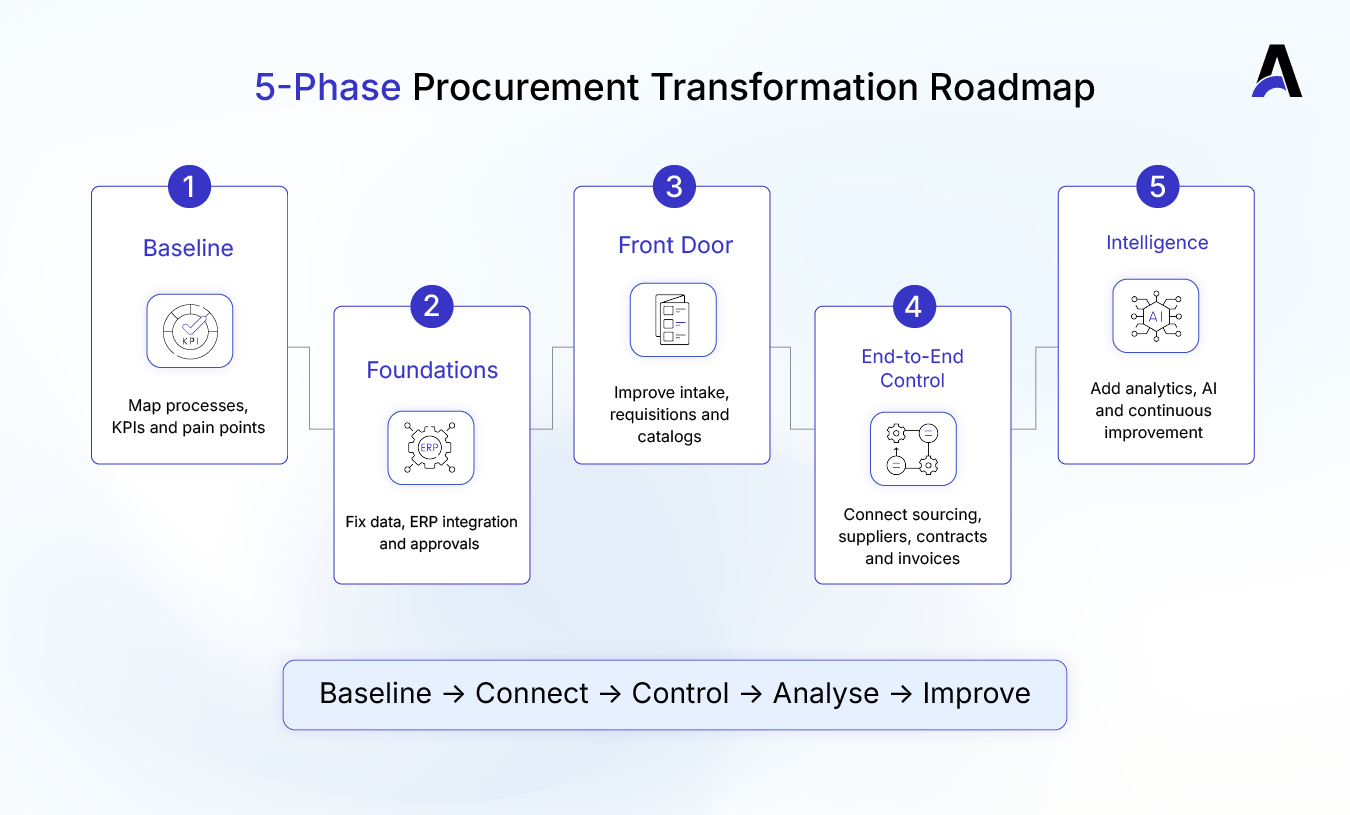
Phase 1: Baseline the current state
Map how a request actually travels from need to payment in two or three representative entities, including the email and spreadsheet steps. Measure spend visibility, spend that reaches a PO, contract coverage, requisition-to-PO time and invoice exception rates. Assess where decisions are made without data.
Exit criteria: an agreed process map, a KPI baseline, a ranked list of pain points, and a decision on whether the primary gap is the system of record or orchestration.
Phase 2: Fix data and integration foundations
Agree the ERP objects the procurement layer must read and write: supplier master, item master, cost centres, GL codes, budgets, approval hierarchies, purchase orders, goods receipts and invoices. Clean supplier duplicates, standardise categories and define who owns each field. Decide where each master record is created and how changes synchronise.
Exit criteria: documented data ownership, a mapped integration design for each ERP instance, and an approval matrix aligned with Delegation of Authority.
Phase 3: Redesign the front door
Start where users feel the change: intake management, purchase requisitions and catalogs. Route routine items through catalogs with contract-linked pricing, give non-catalog requests a structured form, and apply approval rules by value, category and budget. Keep an urgent path inside the system so people do not return to email.
Exit criteria: a stated share of requests entering through the new channel, approvals running on the agreed matrix, and POs created from approved requests without re-keying.
Phase 4: Extend control across sourcing, suppliers, contracts and invoices
Once requests and data are stable, connect the upstream and downstream steps: strategic sourcing, supplier onboarding, contract lifecycle management and invoice matching. The aim is continuity: sourcing outcomes become contracts, contracts govern POs, receipts feed matching, and exceptions follow a defined route.
Exit criteria: awarded prices reaching POs without manual transfer, onboarding time and invoice first-pass match rate measured against the baseline, and exception queues with named owners.
Phase 5: Add intelligence and continuous improvement
With connected, clean data, spend analytics and AI-assisted features become useful rather than speculative. Add category dashboards, savings tracking, supplier risk signals and anomaly detection, and set rules for where AI recommends and where a human approves. Review KPIs on a regular cadence and feed lessons back into earlier phases.
Be precise about what AI does at this stage. Machine learning can classify spend and flag anomalies, and generative assistants can summarise supplier or contract information, but approvals, exceptions and supplier decisions still need defined human owners. Document which decisions AI may recommend, which it may route and which it may never decide alone.
Exit criteria: analytics used in category and budget reviews, and a documented governance model for AI-assisted decisions.
How Should You Prioritise Which Processes to Transform First?
Prioritise by value, ERP dependency and change effort. Initiatives that deliver visible value with limited ERP change should go first, because they build credibility for the harder phases.
| Initiative | ERP dependency | Change effort | Why sequence it here |
|---|---|---|---|
| Spend baseline and classification | Read-only data extract | Low | Creates the evidence for every later business case |
| Intake and requisition workflow | Cost centres, budgets, approvals | Medium | Most users feel it, and it removes email-based buying |
| Catalogs for repeat purchases | Item and supplier master | Medium | Brings contract pricing into everyday buying |
| Sourcing and award to PO continuity | Supplier master, PO creation | Medium to high | Needs clean data and agreed category ownership |
| Invoice matching and exceptions | PO, receipts, invoices | High | Depends on reliable PO and receipt discipline |
| AI-assisted analytics and recommendations | Clean cross-module data | Medium | Value depends on the earlier phases |
What ERP Integration Does Procurement Transformation Require?
A procurement orchestration layer should exchange the required master data and procurement transactions with the ERP in both directions where the process requires it. Otherwise, teams may need to re-key approved outcomes, creating duplicate effort and weakening process continuity.
SAFAL describes its integrations and APIs as pre-built, bi-directional connectors for SAP ECC, SAP S/4HANA, Oracle, Microsoft Dynamics and Navision. It lists supplier, item and cost centre master data and purchase orders, goods receipts and invoices among the data exchanged, and states that financial postings route to the correct ERP instance by entity. It also describes REST APIs, webhooks and middleware compatibility for environments that use an integration platform.
How Should You Govern the Programme and Manage Change?
Governance should name one accountable executive, a cross-functional steering group and clear decision rights for process, data and policy. Because siloed ways of working was the most cited barrier in Deloitte's survey, the steering group should include procurement, finance, IT and the plants or business units that will use the process.
- Decision rights: define who approves process design, category ownership, policy exceptions and changes to the approval matrix.
- Plant and business unit champions: give each location a named owner who can test, train and report friction.
- Supplier adoption: plan communication, onboarding support and portal training before suppliers are asked to change how they work.
- Policy alignment: update procurement policy so that the new channel is the compliant channel, including the urgent path.
- Training by role: requesters, approvers, buyers and finance users need different guidance.
Which KPIs Show That Procurement Transformation Is Working?
Track a short set of KPIs per phase, each measured against the Phase 1 baseline. Choose KPIs that show control and process performance, not just savings, since savings take longer to realise and are harder to attribute.
| KPI | What it measures | Why it matters |
|---|---|---|
| Spend under management | Share of spend covered by managed processes or agreements | Shows reach of the transformation |
| Requisition-to-PO time | Elapsed time from approved request to issued PO | Shows front-door efficiency |
| PO coverage (non-PO spend) | Share of spend that follows an approved PO | Shows buying control |
| Contract coverage | Share of spend under a valid contract or catalog price | Shows price compliance |
| Supplier onboarding time | Time from request to approved supplier record | Shows supplier-side friction |
| Invoice first-pass match rate | Share of invoices matched without manual intervention | Shows data and process quality |
| Realised savings | Savings reconciled against actual spend | Shows financial outcome |
How Do You Build the Business Case Without Overpromising?
Build the business case from your own baseline, phase by phase, rather than from generic benchmarks. A defensible case has four components: the value levers, the cost to deliver, the dependencies and the measures that will confirm results.
- Value levers: price and contract compliance, reduced non-PO spend, faster cycle times, lower invoice handling effort and better supplier terms.
- Costs: licences, integration work, data cleansing, internal time, training and supplier onboarding.
- Dependencies: data quality, ERP integration, executive sponsorship and plant participation.
- Confirmation: KPIs and savings reconciled against actuals, reviewed by finance.
Present phase-level cases, so approval for Phase 3 does not depend on forecasting Phase 5 benefits. Treat vendor or analyst benchmarks as context, and label any estimate that you have not validated against your own data.
How Does the Roadmap Change by Industry?
- Manufacturing: plant-level buying and overlapping item codes make data and catalogs an early priority. See manufacturing procurement.
- EPC and infrastructure: project budgets, BOQ-based sourcing and technical evaluation steer the sourcing phase. See EPC and infrastructure procurement.
- Oil and gas: supplier qualification and technical specifications weigh heavily on supplier and contract controls. See oil and gas procurement.
- Pharmaceuticals: approved supplier status and audit trails shape onboarding and compliance design. See pharmaceutical procurement.
Which Mistakes Should You Avoid in a Procurement Modernization Programme?
Five mistakes recur in ERP-centred procurement programmes, and each can be avoided with a decision made early.
- Treating the ERP as the whole answer or the whole problem. Diagnose the gap first, then choose between remediation, extension or replacement.
- Automating a broken approval path. Agree the approval matrix and Delegation of Authority before configuring workflows.
- Launching every module together. Each phase needs its own data work, training and exit criteria.
- Ignoring the urgent request. If emergency buying has no governed route, users will create their own.
- Measuring go-live instead of adoption. A live workflow that handles a small share of spend has not changed the operating model.
SAFAL Insight: Transformation Succeeds When Execution Stays Connected
Many procurement programmes produce a good design and a weak outcome because execution splits across tools that do not share context. Intake lives in one system, sourcing in another, contracts in a folder and invoices in the ERP. Each tool may work, but no one can see a request from need to payment.
The roadmap above avoids that by treating connected execution as the goal. Each phase adds a step to one governed flow, with the ERP keeping its role as the system of record. This is also why the order matters: connecting workflows before the data is clean only moves the inconsistencies faster.
How Does SAFAL Support a Phased Procurement Transformation?
SAFAL's Source-to-Pay platform includes a procurement orchestration module that, in its own description, coordinates requests, approvals, sourcing events, contracts, orders and invoices across teams, suppliers and ERP systems "without replacing any of them." That maps onto the phases above: intake, requisition and catalog capabilities for the front door; sourcing, supplier, contract and invoice matching modules for end-to-end control; and spend analytics for the intelligence phase.
Because each module can be adopted in sequence, teams can start with the area that carries the most friction. For help choosing between options, see SAFAL's procurement software selection framework, and for the full process view, the Source-to-Pay guide.
Conclusion
Procurement transformation works best as a sequence of connected, measurable steps. Diagnose whether the gap is in the system of record or in orchestration, fix data and integration foundations, redesign the front door, extend control across sourcing, suppliers, contracts and invoices, and only then layer analytics and AI on trusted data.
The most useful next step is a baseline. Map one representative entity from request to payment, measure five KPIs, and decide which phase will deliver the most visible value first.
To see how a phased approach could work with your ERP landscape, book a SAFAL demo and discuss your current procurement flow with the team.
Frequently Asked Questions

Mohammad Ali Holda
Mohammad Ali Holda has built SAFAL's enterprise client portfolio across India and the GCC through a consultative, environment-first approach.