



























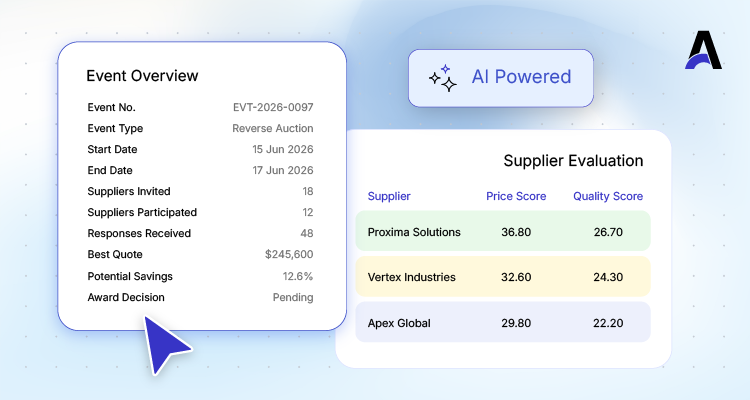
Sourcing management software helps enterprises plan, execute and monitor strategic sourcing activities, from spend analysis and category strategy to supplier evaluation, RFx events, negotiation, award and contract handoff. Enterprises should select it by mapping each stage of their sourcing process to a capability, then testing the handoff into contracts, orders and the ERP. This guide helps CPOs, category managers and procurement leaders compare sourcing platforms with a weighted framework.
Key Takeaways
What Is Sourcing Management Software?
Sourcing management software, also called sourcing software or a sourcing platform, is a system that manages how an organisation selects suppliers and agrees commercial terms. It covers analysis, strategy, supplier engagement, bidding, evaluation, negotiation and award, and records every step.
Related terms overlap, but they are not identical:
- Strategic sourcing software emphasises category strategy, spend analysis and structured supplier selection for larger or more complex categories.
- E-sourcing tools focus on running online events such as RFQ, RFP and auctions. SAFAL covers these in its guide to e-sourcing tools.
- E-procurement manages requisitions, purchase orders and receipts after a supplier is chosen.
- Source-to-Pay connects sourcing with contracts, purchasing, invoices and payment.
How Does the Sourcing Process Map to Software?
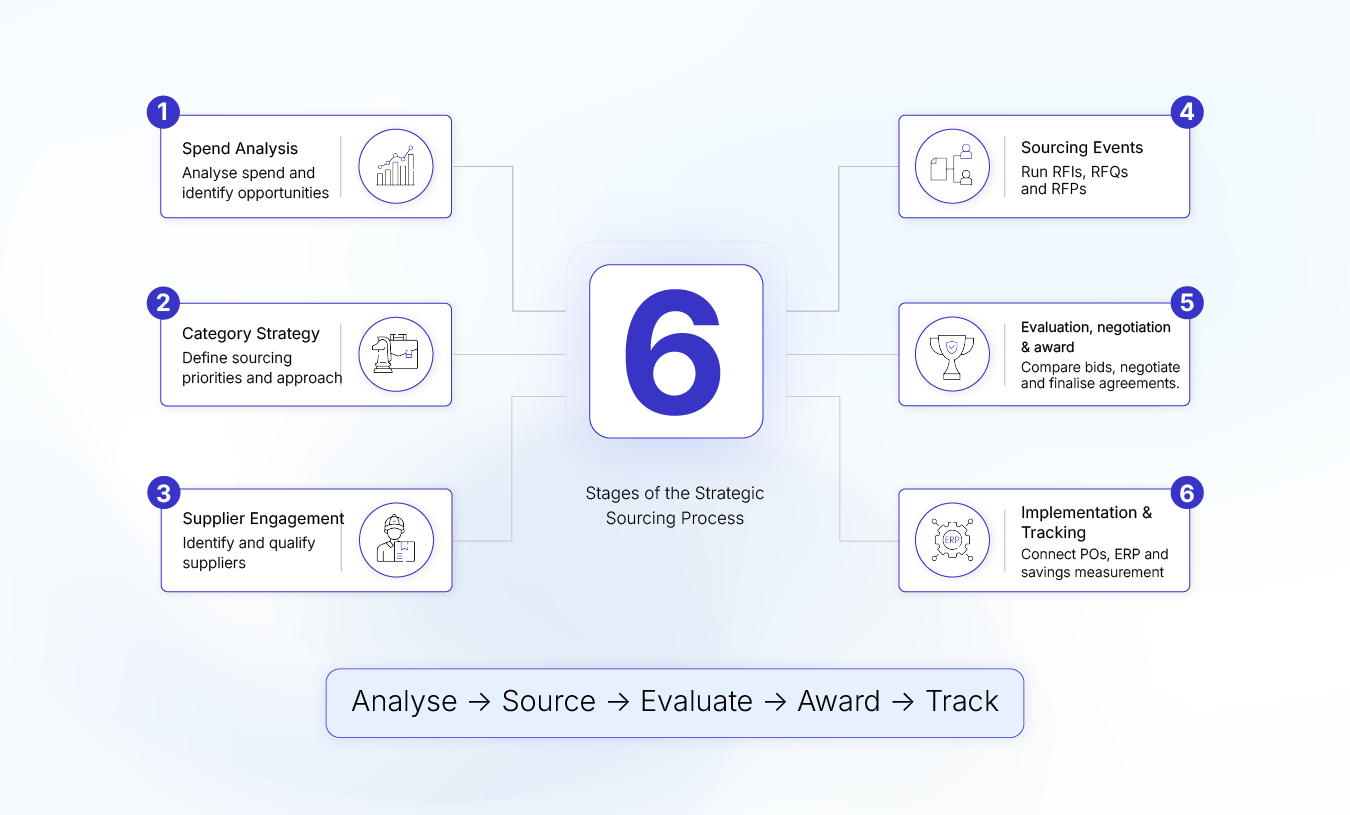
A strategic sourcing process moves through analysis, strategy, supplier engagement, negotiation, award and implementation. Software should support every stage and carry information from one stage to the next.
Which Sourcing Strategies Should the Software Support?
Sourcing strategies should differ by category, and software should support each approach. Peter Kraljic's widely used model, published in Harvard Business Review in 1983, sorts purchased items by profit impact and supply risk into four groups: strategic, bottleneck, leverage and noncritical items.
| Category type | Profit impact and supply risk | Typical sourcing approach | What software should support |
|---|---|---|---|
| Leverage | High impact, low risk | Competitive bidding and negotiation | RFQ, auctions, side-by-side comparison, landed cost |
| Strategic | High impact, high risk | Partnership, joint planning, long-term agreements | RFP, technical evaluation, supplier performance, contracts |
| Bottleneck | Low impact, high risk | Secure supply, qualify alternatives | Supplier qualification, risk signals, contract terms |
| Noncritical | Low impact, low risk | Simplify and automate | Catalogs, standard templates, light approvals |
The matrix is a starting point, not a rule. Use it to decide where to apply auctions, where to invest in supplier relationships and where to automate buying so category managers spend time on the categories that matter.
What Features Should Sourcing Management Software Have?
Enterprise sourcing management software should support RFx events, bid evaluation, negotiations, supplier collaboration, award management, spend analytics, ERP integration and procurement governance.
| Feature area | What to verify |
|---|---|
| Event types | RFI, RFQ, RFP and tender events, multi-round events and reusable templates |
| Bid collection | Template-based bids, mandatory field validation, unit and currency normalisation |
| Evaluation | Weighted scoring, technical evaluation before commercial, landed and total cost analysis |
| Auctions and negotiation | Supported auction formats, decrement and reserve rules, live monitoring |
| Supplier collaboration | Invitation, clarifications visible to all bidders, supplier portal, reminders |
| Award and handoff | Recommendation with rationale and approvals, contract and PO creation |
| Analytics | Cycle time, participation, savings against baseline, pipeline view |
| Governance | Time-stamped audit trail, role-based access, sealed-bid controls |
| Integration | ERP connectors, supplier master synchronisation, APIs |
What Types of Sourcing Platforms Exist?
| Platform type | Typical strength | Typical consideration |
|---|---|---|
| ERP-native sourcing module | Close fit with ERP master data | Sourcing depth and supplier experience vary |
| Specialist sourcing tool | Focused events, auctions and evaluation | Contract, PO and ERP handoff may need integration |
| Source-to-Pay suite | Sourcing linked to contracts, POs and invoices | Broader scope can lengthen rollout if all modules start together |
| Repository-only tool | Fast, low-effort storage and search | Limited workflow, obligation and renewal control |
| Orchestration layer over the ERP | Works across ERPs and keeps ERP as system of record | Needs clear data ownership and integration design |
Which Is the Best Strategic Sourcing Software?
No single product is the best strategic sourcing software for every enterprise. The best choice depends on your category mix, sourcing strategies, ERP landscape, supplier base and governance needs. Shortlists of the best strategic sourcing software are useful for finding names, but check how they were produced.
Be cautious when a ranking uses binary yes/no columns that mark nearly every vendor identically, mixes sourcing tools with accounts payable tools, or repeats statistics without naming a source. A feature table can show that a capability exists. It cannot show how well it works, how hard it is to configure or whether it fits your processes.
How Should You Select Sourcing Software? A Weighted Framework
Use a weighted scorecard of eight criteria. Agree the weights with procurement, finance, IT and the business before you see a demo, and score only what you have witnessed.
| Criterion | Key question | Evidence to request |
|---|---|---|
| 1. Process coverage | Does it support your event types, categories and strategies? | Live run of your own RFQ or RFP |
| 2. Evaluation depth | Can it split technical and commercial scoring with weights? | Sample scoring sheet and award recommendation |
| 3. Auctions and negotiation | Which formats and controls are configurable? | Mock auction with your rules |
| 4. Supplier experience | Can a first-time supplier respond without training? | Supplier-side walkthrough |
| 5. Handoff to contract and PO | Do awards become contracts and orders with prices intact? | End-to-end demonstration |
| 6. ERP integration | Do supplier, contract and PO data synchronise with your ERP? | Integration design for your landscape |
| 7. Governance and security | Which audit, access and certification evidence exists? | Audit log sample, certificates and scope |
| 8. Rollout and total cost | What resources and costs are required? | Itemised proposal and rollout plan |
Why Do Supplier Experience and Adoption Decide Results?
A sourcing platform delivers value only if suppliers respond. If registration is slow, templates are confusing or deadlines are unclear, participation falls and bids arrive late or incomplete. Buyers often score their own screens and forget that the supplier side decides how competitive an event becomes.
Test the supplier journey directly: how a supplier accepts an invitation, finds documents and rules, asks a question, submits a bid and sees the outcome. Plan enablement too, including a briefing for key suppliers and a named contact for their first events.
How Do You Prove a Sourcing Platform Before Buying?
Replace scripted demos with a proof run using your own sourcing scenarios:
- Run a real RFQ with your item list, units, currencies and several supplier contacts.
- Run a technical and commercial RFP with weighted criteria and at least two evaluators.
- Run a mock auction using your decrement, reserve and time extension rules.
- Award the event and show the contract and PO created in your ERP or test environment.
- Ask a supplier who has never used the platform to respond and note what help they needed.
- Review the audit log and the event report.
What ERP Integration Do Sourcing Platforms Need?
Sourcing results must reach the ERP. Expect supplier master data to flow into the sourcing platform and awarded commitments to flow back, so that purchase orders carry the agreed supplier and price. SAFAL describes native integration with SAP, Oracle, Microsoft Dynamics and Navision, with sourcing outcomes flowing into the ERP for supplier master updates, contract posting and PO creation. Details are on its integrations and APIs page.
Whatever platform you assess, ask who owns supplier master data, how failed synchronisations are handled and how several ERP instances or legal entities are supported.
Which Security and Governance Evidence Should You Request?
Ask for evidence, not badges. ISO describes ISO/IEC 27001 as "the internationally recognized standard for establishing, implementing, maintaining, and continually improving" an information security management system, and notes certification is voluntary. Confirm the certificate scope covers the product you will use. Then check sealed-bid controls, role-based access, segregation between event creators and approvers, and a time-stamped log of invitations, bids, scores and awards.
What Role Does AI Play in Sourcing Software?
AI in sourcing software typically assists analysis and comparison rather than making award decisions. Examples include flagging outliers and variances between bids, classifying spend and suggesting suppliers for invitation. These are assistive uses of machine learning and analytics, and sourcing owners remain accountable for awards.
When a vendor describes AI features, ask what data the model uses, how its outputs are reviewed and where a human approval step sits in the workflow.
How Should You Implement Sourcing Management Software?
Start with two or three categories where specifications are clear and supplier markets are competitive, then extend to complex categories. A phased approach lets the team fix templates, scoring rules and ERP handoff before volume grows.
- Standardise templates. Agree RFQ, RFP and tender templates by category type.
- Define evaluation rules. Set standard criteria and weights, and who may change them.
- Clean supplier data. Resolve duplicate and incomplete supplier records before inviting suppliers.
- Set thresholds. Define which values and categories require events and which approvals apply.
- Enable suppliers. Brief key suppliers, offer support and explain what changes.
- Review after each event. Capture lessons, update templates and reconcile savings.
Which KPIs Show That Sourcing Software Is Working?
| KPI | What it shows |
|---|---|
| Sourcing cycle time | Elapsed time from event launch to award |
| Supplier participation rate | Share of invited suppliers that submit a bid |
| Spend sourced through events | Share of addressable spend that goes through structured sourcing |
| Savings against baseline | Savings from an agreed baseline, reconciled to actual purchases |
| Award-to-PO conformance | Share of POs carrying the awarded supplier and price |
Treat savings figures with care. A saving counts when the baseline was set in advance and the awarded price appears in actual purchases.
How Do Needs Differ by Industry?
- Manufacturing: multi-plant direct and indirect categories raise the importance of award-to-PO continuity. See manufacturing procurement.
- EPC and infrastructure: technical evaluation before commercial comparison and BOQ-based tenders shape the design. See EPC and infrastructure procurement.
- Oil and gas: supplier qualification and technical specifications weigh heavily. See oil and gas procurement.
- Chemicals: compliance and safety requirements affect supplier qualification. See chemical procurement.
SAFAL Insight: Sourcing Value Is Lost After the Award
Teams often judge sourcing software by the event screens and ignore what happens after the award. Yet savings are lost when awarded prices are re-keyed into contracts, when buyers cannot see contract prices at purchase, or when the supplier master differs from the sourcing record.
This is why enterprises with several plants or ERPs evaluate sourcing as a connected flow. The ERP stays the system of record, while the sourcing platform coordinates analysis, events, award and contract before the order is raised.
How Does SAFAL Support Sourcing Management?
SAFAL's Source-to-Contract capability covers spend analysis, e-sourcing, RFx management, e-auctions, negotiation management and contract lifecycle management, with the aim that every stage informs the next. According to SAFAL, an awarded sourcing event converts directly into a contract in the same platform, and the contract then governs later purchase orders.
SAFAL's e-sourcing supports RFI, RFQ, RFP and eTender events with weighted technical scoring, landed-cost comparison and a time-stamped audit trail, and e-auctions supports English, Dutch, Japanese and ranked formats. It connects with RFx management, negotiation management and contract lifecycle management. For spend analysis and savings tracking, see spend analytics. SAFAL also covers contract selection in its contract management software guide.
Conclusion
The right sourcing management software supports your category strategies, runs the events your teams actually need and carries results into contracts, purchase orders and the ERP. Weight your criteria first, test with your own scenarios and judge the handoff as carefully as the event.
A practical next step is to take one category from each Kraljic group, write down the sourcing approach for each, and use the eight criteria to see which platforms support all of them.
To see how sourcing connects to contracts, orders and your ERP, book a SAFAL demo and bring a sample RFQ or RFP.
Frequently Asked Questions

Ashish Patel
Ashish Patel is Head of Technology at SAFAL, with expertise in enterprise application architecture, solution design, software development, and procurement technology.