























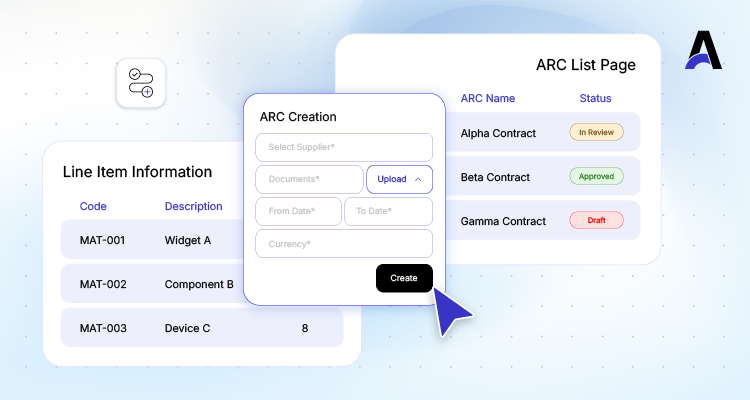
Contract management software is a system that creates, negotiates, approves, signs, stores and monitors contracts across their full lifecycle, so that obligations, renewals and commercial terms are visible and enforced. Buyers should compare CLM platforms against their own contract types, approval rules, ERP environment, supplier workflows and governance requirements rather than relying on feature lists alone. This guide helps procurement, legal, finance and IT leaders evaluate platforms, with a focus on supplier and procurement contracts. For SAFAL's own approach, see its contract lifecycle management solution.
Key Takeaways
What Is Contract Management Software?
Contract management software manages contracts from request and drafting through negotiation, approval, signature, obligation tracking, renewal and expiry in one governed system. It replaces scattered documents, email chains and spreadsheets with one governed record.
The terms are used loosely, so be precise when you shortlist:
- Contract repository: stores and searches signed contracts, but does little to create or manage them.
- Contract management system: adds workflows, approvals and tracking to the stored record.
- Contract lifecycle management (CLM) software: covers the whole lifecycle, including authoring, negotiation, obligations and renewals.
Why Does Contract Management Matter Financially?
Poor contract management leaks value because terms agreed at signature are not always the terms delivered. WorldCC's contract management research states that "the average business loses almost 9% of value annually through poor contract management," with the best performers losing about 3% and the worst 15% or more. WorldCC defines value erosion as "the deviation from expected results."
Fragmentation is part of the cause. A 2023 Deloitte analysis drawing on WorldCC and Deloitte survey data from more than 1,200 organisations found that contract-related data in large organisations sits, on average, in 24 different systems. These figures describe contracting generally, not any single product, and your own exposure depends on contract volume and complexity.
When Should You Invest in Contract Management Software?
Invest when contract volume, complexity or risk exceeds what shared folders and spreadsheets can control. These signals usually appear together:
- Buyers or legal teams cannot quickly find the current version of a supplier contract.
- Renewals and notice periods are discovered late, after auto-renewal has occurred.
- Approvals run by email, and nobody can confirm who approved which terms.
- Purchases are made at prices that differ from contract prices.
- Several plants or entities use different templates and clauses for the same supplier.
- Auditors ask for contract history and the team has to assemble it manually.
What Features Should Contract Management Software Have?
Look for capabilities across the whole lifecycle, and test each one against a real contract. The table maps stages to the capabilities and demo questions that matter most.
| Lifecycle stage | Capability | What to test |
|---|---|---|
| Request and authoring | Approved templates, clause library, auto-populated terms | Can a buyer draft from a template with fallback clauses and sourcing terms pre-filled? |
| Negotiation | Redlining with version history, supplier access | Can suppliers review and redline without email attachments? |
| Approval | Workflows by value, category and entity | Does routing follow your Delegation of Authority? |
| Signature | E-signature integration | Is signature part of the workflow, and does it meet your jurisdictions' requirements? |
| Storage and search | Central repository, metadata, access control | Can you retrieve by supplier, category, value and expiry? |
| Obligations | Obligation, milestone and SLA tracking | Are key dates and responsibilities extracted and assigned? |
| Renewal and amendment | Alerts, renewal and amendment workflows | Do notice-period alerts fire early enough to renegotiate? |
| Reporting | Portfolio views, audit trail | Can finance and legal see exposure across entities? |
How Does Procurement Contract Management Differ?
Procurement contract management focuses on supplier and purchasing agreements, and links them to sourcing outcomes, purchase orders and supplier performance. General CLM tools often start from legal or sales workflows, so procurement teams should check these links explicitly.
| Area | General CLM focus | Procurement contract management focus |
|---|---|---|
| Source of terms | Legal templates and negotiation | Sourcing awards and negotiation outcomes |
| Downstream link | Signed document stored | Contract prices and suppliers governing POs and receipts |
| Performance | Obligations and renewals | SLA and supplier performance against contract terms |
| Approval rules | Legal and risk review | Value, category, entity and budget thresholds |
| Systems | CRM, e-signature, document stores | ERP, supplier master, PO and goods receipt data |
A common failure is the gap between a signed contract and the order. If buyers cannot see contract prices at the point of purchase, off-contract buying continues. See the wider flow in SAFAL's Source-to-Pay guide.
What Types of Contract Management Platforms Can You Choose?
| Category | Typical strength | Typical consideration |
|---|---|---|
| Standalone CLM | Deep authoring, clause and legal workflow functions | Procurement, PO and ERP links may require integration work |
| Source-to-Pay suite module | Contracts connected to sourcing, POs, suppliers and invoices | Best value comes when adjacent modules are also in use |
| ERP-native contracts | Close alignment to ERP data | Authoring and negotiation depth varies |
| Repository-only tool | Fast, low-effort storage and search | Limited workflow, obligation and renewal control |
Which Is the Best CLM Software in 2026?
There is no single best CLM software for every enterprise, because the right choice depends on contract types, owners, ERP landscape and governance needs. Lists of the best CLM software in 2026 are useful for finding names, but treat them cautiously when they give no methodology, rank their own publisher first or repeat figures without a source. Build your own scorecard instead.
How Should You Evaluate and Compare Platforms?
Use a weighted scorecard of eight criteria, with weights agreed by procurement, legal, finance and IT before any demo.
| Criterion | Key question | Evidence to request |
|---|---|---|
| Lifecycle coverage | Does it cover authoring to renewal for your contract types? | Live run of one of your contracts |
| Procurement linkage | Do sourcing terms flow in and contract prices flow to POs? | End-to-end demo from award to PO |
| Workflow and approvals | Can it model your DoA by value, category and entity? | Configured approval matrix |
| Clause and template control | Are fallback clauses and deviations managed? | Sample clause library and deviation report |
| ERP and system integration | Does it connect to your ERP, supplier master and e-signature? | Integration design for your landscape |
| Security and audit | Which certifications, access controls and audit logs apply? | Certificates, scope and audit log sample |
| Usability and adoption | Can business users and suppliers use it without training? | User and supplier walkthroughs |
| Cost and rollout | What are all licence, implementation and support costs? | Itemised proposal and rollout plan |
For the broader selection process, see SAFAL's procurement software selection framework.
What Integrations Does Contract Management Software Need?
At minimum, expect integration with your ERP, supplier master data, an e-signature service and a document store. For procurement contracts, the ERP link matters most, since it keeps contract terms aligned with supplier records and orders. SAFAL describes bi-directional connectors for SAP ECC and S/4HANA, Oracle, Microsoft Dynamics and Navision on its integrations and APIs page. Whatever the vendor, ask which fields synchronise, how failures are handled and how multiple entities are supported.
Which Security and Compliance Evidence Should You Request?
Ask for certificates and scope, not just badges. ISO describes ISO/IEC 27001 as "the internationally recognized standard for establishing, implementing, maintaining, and continually improving" an information security management system, and notes that certification is voluntary. Also check role-based access, full contract history, an audit trail of changes and approvals, and data location. Confirm that e-signature options satisfy the legal requirements in each country where you sign contracts.
How Does Contract Software Support Compliance and Audit?
Contract software supports compliance by keeping an authoritative, time-stamped record of what was agreed, who approved it and what changed. Auditors and internal reviewers can then trace a purchase back to its contract, approval and amendment history without assembling documents by hand.
Look for version history on every draft, approval records tied to named users, controlled access to sensitive agreements and reports on expiring or non-compliant contracts. For related controls, see SAFAL's policy and compliance management and audit and governance solutions.
What Role Does AI Play in Contract Management?
AI in contract management typically assists with drafting and review rather than deciding. Common uses include suggesting clauses, flagging deviations from approved language and extracting dates, obligations and values from documents. These are assistive functions, and legal and commercial owners should still approve non-standard terms.
When a vendor describes AI features, ask what the model does, what data it uses, how outputs are reviewed and whether a human approval step is built into the workflow. Avoid claims that AI removes contract risk.
How Should You Implement Contract Management Software?
Implementation succeeds when contract data, templates and approval rules are ready before configuration. A phased approach by contract type or entity keeps risk manageable.
- Inventory contracts. Locate contracts across shared drives, email, ERP attachments and plants, and decide what to migrate.
- Standardise templates and clauses. Agree standard, fallback and alternative language with legal.
- Define metadata. Agree the fields to capture, such as supplier, category, value, entity, start date, end date and notice period.
- Set approval rules. Map approval chains by value, category and entity to your Delegation of Authority.
- Prepare suppliers. Explain how suppliers will review and redline, and provide support.
- Start with a pilot. Begin with a high-volume supplier contract type, then expand.
What Does Contract Management Software Cost?
Costs vary by vendor, contract volume, modules and users, so ask for an itemised proposal. Compare the same components across vendors: licence or subscription model, implementation and configuration, legacy contract migration, integrations, training and support, and internal time. Be cautious about published price ranges that give no source or scope.
What Mistakes Should Buyers Avoid?
- Buying for the signature step only. E-signature is the easiest part of the lifecycle; obligations, renewals and PO linkage create the value.
- Migrating everything. Moving every legacy document without metadata creates a larger, unsearchable archive. Prioritise active and high-value contracts.
- Leaving suppliers out. If suppliers cannot review and redline easily, negotiation drifts back to email.
- Skipping clause governance. A clause library without owners and fallback rules becomes outdated within months.
- Treating AI output as final. Extracted dates and flagged deviations need review, especially for high-value agreements.
Which KPIs Show That Contract Management Is Working?
- Contract cycle time: time from request to signature.
- Contract coverage: share of spend under a valid contract.
- Price conformance: share of POs that carry contracted prices.
- Renewal notice compliance: share of renewals actioned before the notice deadline.
- Clause deviation rate: share of contracts using non-standard clauses.
- Obligation completion: share of milestones and SLAs tracked and met.
How Do Needs Differ by Industry?
- Manufacturing: plant-level supplier agreements and price conformance matter most. See manufacturing procurement.
- EPC and infrastructure: subcontract terms, milestones and project budgets drive requirements. See EPC and infrastructure procurement.
- Pharmaceuticals: approved suppliers and audit-ready records shape governance. See pharmaceutical procurement.
- Oil and gas: long-term agreements and compliance obligations need reliable tracking. See oil and gas procurement.
SAFAL Insight: A Contract Is Only Useful If Buyers Can Follow It
Many contract programmes invest in storage and signature, then find that buyers still cannot see the agreed price when they raise a requisition. The contract exists, but it does not shape the purchase.
That is why procurement-led buyers should evaluate how a platform connects contracts to sourcing awards upstream and purchase orders downstream. The system of record for the contract should work with the ERP, while the contract workflow coordinates everything that happens around it.
How Does SAFAL Support Contract Lifecycle Management?
SAFAL's contract lifecycle management includes a central searchable repository, pre-approved templates and clause libraries, collaborative redlining with version history, multi-level approval workflows by value and category, digital signature integration, obligation, milestone and SLA tracking, and configurable expiry and notice-period alerts. It also describes AI-assisted clause suggestions and deviation detection for non-standard clauses, plus a full audit trail.
For procurement teams, the contract draws on sourcing awards and negotiation outcomes and links to purchasing activity and supplier performance. See Source-to-Contract, negotiation management, purchase order management and supplier performance management.
Conclusion
The best contract management software is the one that fits your contract owners, approval rules, ERP and supplier processes, and proves it on your own contracts. Set weighted criteria first, test the link from sourcing award to contract to purchase order, and plan migration and supplier adoption as seriously as configuration.
A useful first step is to pick one high-volume supplier contract type and walk it through the eight criteria with your procurement, legal, finance and IT stakeholders.
Frequently Asked Questions

Ashish Patel
Ashish Patel is Head of Technology at SAFAL, with expertise in enterprise application architecture, solution design, software development, and procurement technology.