









































UAE e-Invoicing becomes mandatory from 1 January 2027 for the first group of in-scope businesses, marking the shift from conventional invoices to structured electronic invoice exchange and reporting. Getting ready is not a finance-only project. It touches how purchase orders are raised, how supplier and transaction data is maintained, how ERP fields are mapped, and how invoices move between systems. That is why procurement, finance and IT need to prepare together well before the deadline.
This guide explains what the UAE Electronic Invoicing System requires, the confirmed implementation timeline, how the Peppol-based exchange model works, and what enterprises should prepare across procurement, finance and IT. The central point is simple: a compliant eInvoice may be created at the end of the process, but readiness begins much earlier in the procurement lifecycle.
Key Takeaways
What Is UAE e-Invoicing and Who Does It Apply To?
UAE e-Invoicing requires in-scope businesses to issue and exchange structured electronic invoice data through the Electronic Invoicing System and report the required data electronically to the Federal Tax Authority. PDFs, scanned documents and emailed invoices do not qualify as eInvoices. The legal basis is Ministerial Decision No. 243 of 2025, which defines the scope of the system, and Ministerial Decision No. 244 of 2025, which sets out the implementation timeline, both issued by the UAE Ministry of Finance on 28 September 2025.
The mandate currently applies to business-to-business (B2B) and business-to-government (B2G) transactions, with specific exclusions defined under the decisions, including certain sovereign government activities, some international passenger and goods transport services, and certain exempt financial services. Business-to-consumer (B2C) transactions are not yet in scope; the Ministry of Finance has indicated this will be addressed in a later phase.
The UAE e-Invoicing program forms part of a broader move toward structured digital reporting and more connected tax administration. For enterprises, the immediate priority is understanding the required data, exchange model and implementation milestones, then translating those requirements into system, process and governance readiness.
The UAE e-Invoicing Timeline: Key Dates Through 2027
The rollout follows a phased schedule based on business size, with a voluntary pilot preceding mandatory enforcement.
| Phase | ASP Appointment Deadline | Mandatory Go-Live |
|---|---|---|
| Voluntary pilot (invited firms, open adoption) | Not applicable | 1 July 2026 |
| Businesses with revenue ≥ AED 50 million | 30 October 2026 | 1 January 2027 |
| Businesses with revenue below AED 50 million | 31 March 2027 | 1 July 2027 |
| Government entities (B2G) | 31 March 2027 | 1 October 2027 |
The 30 October 2026 ASP appointment deadline for larger businesses was extended from an original date of 31 July 2026, following a Ministry of Finance update in May 2026. The mandatory go-live date of 1 January 2027 for that group has not moved. Businesses should plan backward from both milestones: ASP appointment determines integration readiness, while the mandatory implementation date determines when compliant e-Invoicing must be operational.
Current UAE Ministry of Finance guidance confirms the 30 October 2026 ASP appointment deadline for entities with annual revenue of AED 50 million or more. Revalidate all dates against the latest MoF guidance immediately before publication.
How Does the UAE Peppol Five-Corner Model Work?
The UAE’s final e-Invoicing architecture is based on a Peppol-enabled five-corner model. A 4-corner exchange capability was activated in April 2026, followed by the 5-corner pilot phase in June 2026.
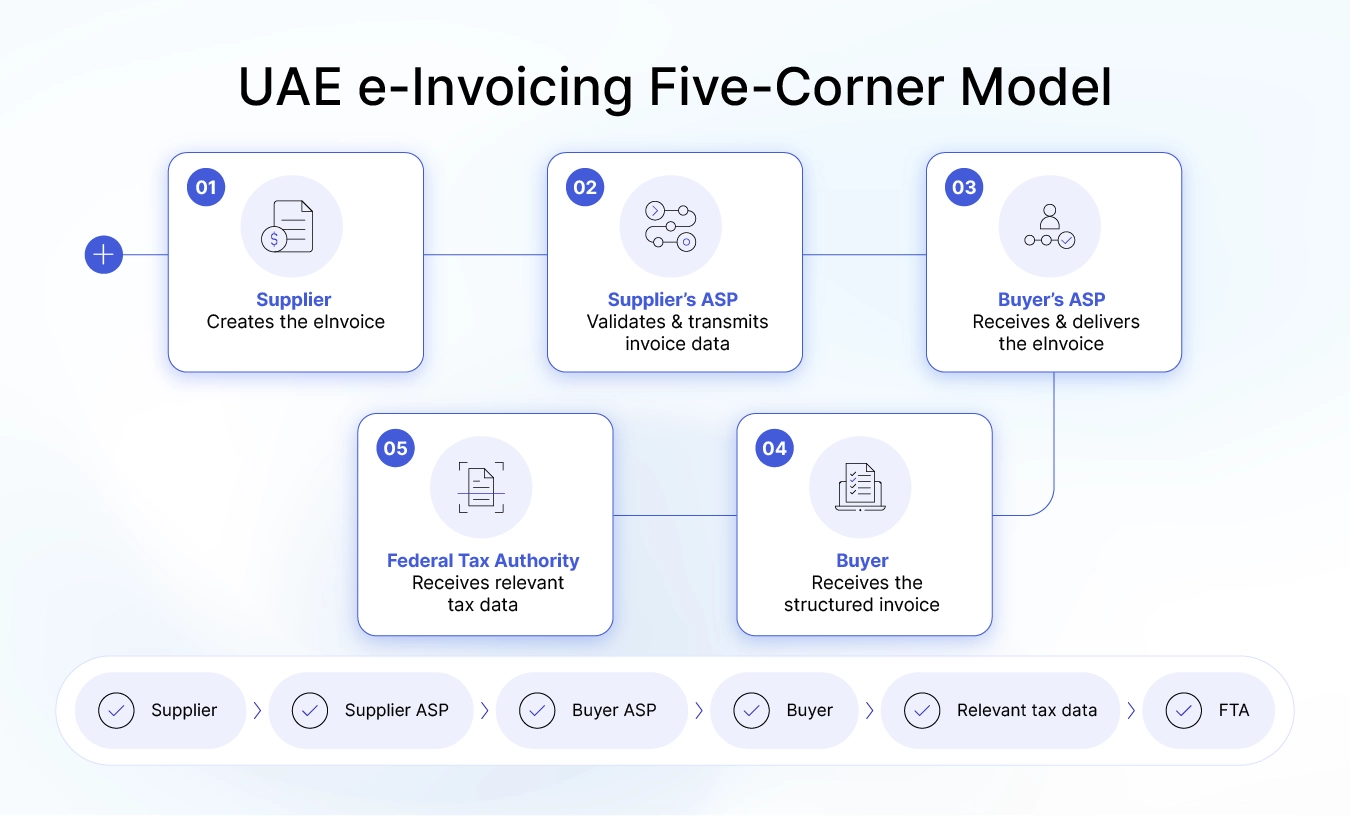
Electronic invoices are exchanged in XML using the UAE's PINT-AE specification, which defines the required structure and data for UAE eInvoices and credit notes. A human-readable version can still be produced for internal use, but it does not replace the structured electronic document used for compliant exchange.
What Are the Penalties for UAE e-Invoicing Non-Compliance?
Cabinet Resolution No. 106 of 2025 sets out the administrative fines that apply once a business is mandatorily subject to the Electronic Invoicing System; businesses using the system voluntarily ahead of their mandatory date are not subject to these fines until their mandatory phase begins.
| Violation | Penalty |
|---|---|
| Failing to implement the Electronic Invoicing System or appoint an ASP by the deadline | AED 5,000 per month or part thereof, until compliant |
| Failing to send an e-invoice or e-credit note to a recipient | AED 100 per document, capped at AED 5,000 per month |
| Failing to notify the Federal Tax Authority of a system malfunction within the required timeframe | AED 1,000 per day of delay |
| Failing to notify the ASP of a change to Authority-registered data within the required timeframe | AED 1,000 per day of delay |
Separate administrative penalties may apply to different violations, so businesses should not assume that one monthly cap covers every type of non-compliance.
Why Procurement, Finance and IT Need to Prepare Together
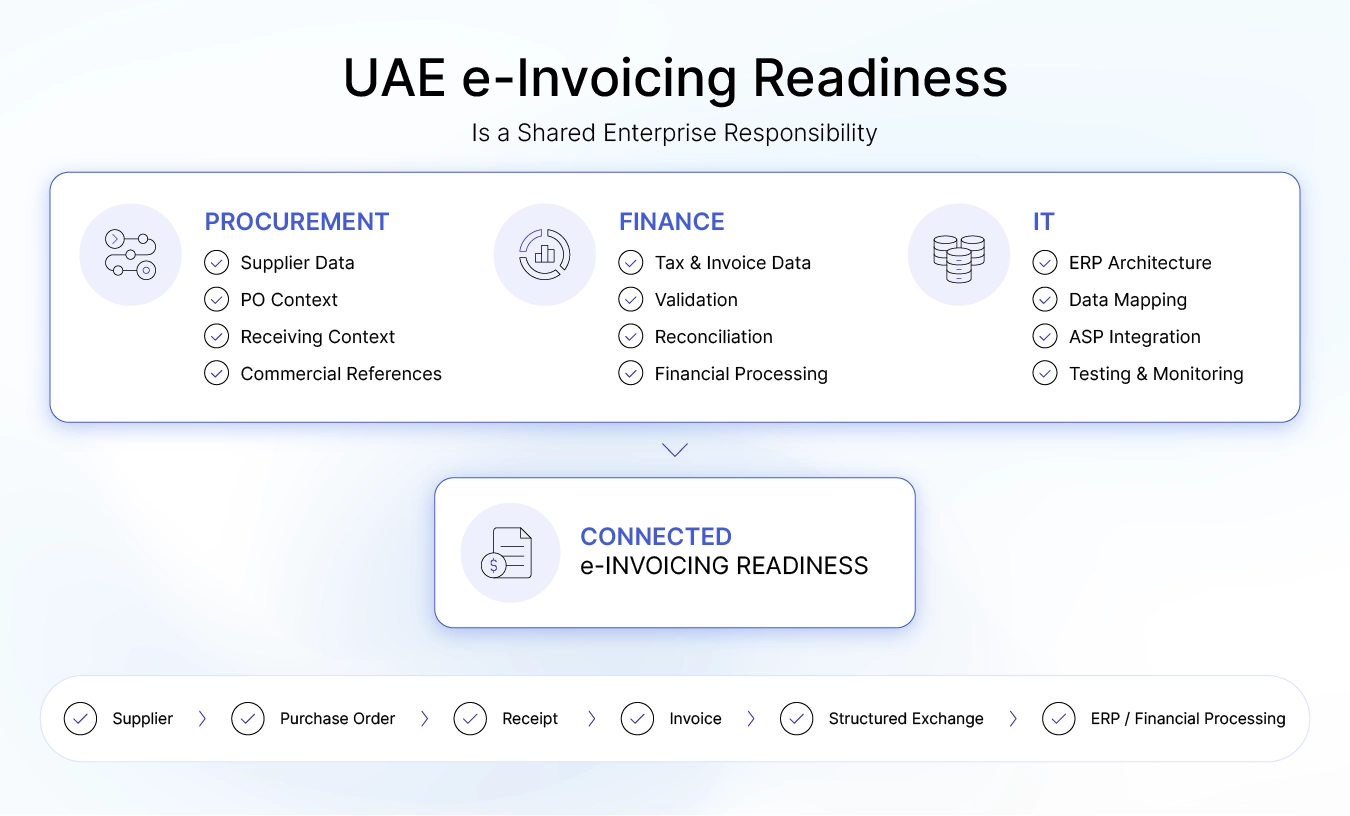
A common readiness risk is treating e-Invoicing as a finance-system change alone. In practice, structured invoice exchange depends on data and system relationships that extend beyond Finance. Procurement contributes supplier, purchase order and receiving context; Finance owns tax, invoice and financial-processing requirements; and IT connects the ERP, ASP and surrounding systems through data mapping, integration and testing.
| Function | What It Owns in This Mandate | What Goes Wrong If Ignored |
|---|---|---|
| Procurement | Purchase order data quality, supplier master accuracy, three-way match discipline | Poor or incomplete upstream data can create matching, reconciliation and exception-handling issues during invoice processing. |
| Finance | VAT treatment rules, ASP selection and contracting, tax data reporting accuracy | Incorrect tax or invoice data can create compliance and processing issues; missed statutory obligations may also result in penalties. |
| IT | ERP field mapping, integration with the chosen ASP, system testing before go-live | Insufficient mapping or testing can create integration, transmission and exception-handling issues as transaction volumes increase. |
These workstreams are interdependent. Finance can define invoice and tax requirements, but procurement and master-data quality can affect matching and reconciliation, while IT needs both functions to agree on the data, ownership and system flows required for implementation. Treating the mandate as one shared readiness program helps surface those dependencies before go-live.
A concrete example makes the dependency clear. If supplier information, purchase-order references or receiving data is incomplete or inconsistent, the issue may surface later as a matching, reconciliation or exception-handling problem during invoice processing. Structured e-Invoicing reduces the room for informal workarounds because data must move consistently across defined system fields and exchange processes. The fix is therefore not only a finance patch; procurement, finance and IT need to agree on data ownership, required fields and exception handling before go-live.
What Enterprises Should Do Before the Deadlines
- Confirm which implementation phase applies to the business based on current annual revenue, and plan backward from both the ASP appointment deadline and the mandatory implementation date.
- Shortlist and appoint a Ministry of Finance accredited service provider with enough lead time for integration and testing, not at the deadline itself.
- Audit supplier, purchase-order, receiving and invoice-related data quality now, and identify which fields are required for compliant exchange, internal matching, reconciliation and downstream processing.
- Map ERP fields to the PINT AE data requirements, working with IT and the ASP together rather than treating it as a downstream finance task, particularly where ERP integration already spans multiple entities or ERP instances.
- Use pilot participation, where invited, or voluntary implementation where appropriate, as a controlled test cycle for integration, validation and exception handling.
- Define ownership across procurement, finance and IT explicitly, including who investigates invoice exceptions when the root cause sits upstream in supplier, purchase-order, receiving or system data.
- Build in a reconciliation check between what the ASP reports as transmitted and what the ERP records as issued, so a silent transmission failure does not go unnoticed until a supplier or the Federal Tax Authority raises it.
Industry Considerations
Readiness becomes more complex when organizations operate across multiple legal entities, ERP instances, supplier masters or purchasing processes, or when transaction volumes and integration dependencies are high. In these environments, the challenge is not simply meeting an invoice-format requirement. It is ensuring that data ownership, field mapping, system integration, testing and exception handling remain consistent across the enterprise. These organizations should begin integration and data-readiness work well ahead of their mandatory milestones.
SAFAL Insight
Much of the guidance around e-Invoicing naturally focuses on tax, invoice and regulatory requirements. Enterprise readiness, however, reaches further upstream. Supplier information, purchase-order context, receiving data, ERP mapping and invoice processing all need to work together if structured exchange is to operate reliably.
The principle is straightforward: a compliant e-Invoice may be created at the end of the process, but readiness begins much earlier in the procurement lifecycle. The stronger the data quality and process continuity upstream, the fewer avoidable exceptions enterprises need to resolve downstream.
Where SAFAL Fits
SAFAL approaches e-Invoicing as part of the connected Procure-to-Pay environment rather than as an isolated invoice-processing step. Purchase orders, receiving, invoice processing and ERP transactions are part of the same enterprise data flow. By connecting these procurement activities with enterprise ERP environments, SAFAL can support the process and data continuity required as organizations prepare for structured e-Invoicing.
The objective is not to replace the ERP or the Accredited Service Provider. Each plays a different role: the ERP remains central to enterprise transaction and financial processing, the ASP enables compliant electronic invoice exchange, and procurement orchestration helps maintain the workflow and business context surrounding the invoice. For enterprises preparing for UAE e-Invoicing, that architecture reinforces an important principle: compliance at the invoice stage depends on the quality and continuity of the process that came before it.
Conclusion
UAE e-Invoicing 2027 is a regulatory deadline with real consequences for non-compliance, but enterprise readiness extends beyond the legal requirement itself. Procurement, finance and IT need to ensure that the data, system mappings, integrations and operating responsibilities surrounding invoice processing are ready for structured electronic exchange.
Organizations that treat e-Invoicing as one shared readiness program can identify cross-functional dependencies earlier, test integrations more deliberately and address data or process gaps before mandatory implementation.
See how SAFAL connects invoice processing, procurement data and ERP workflows to support enterprise e-Invoicing readiness.
Frequently Asked Questions

Ashish Patel
Ashish Patel is Head of Technology at SAFAL, with expertise in enterprise application architecture, solution design, software development, and procurement technology.