




















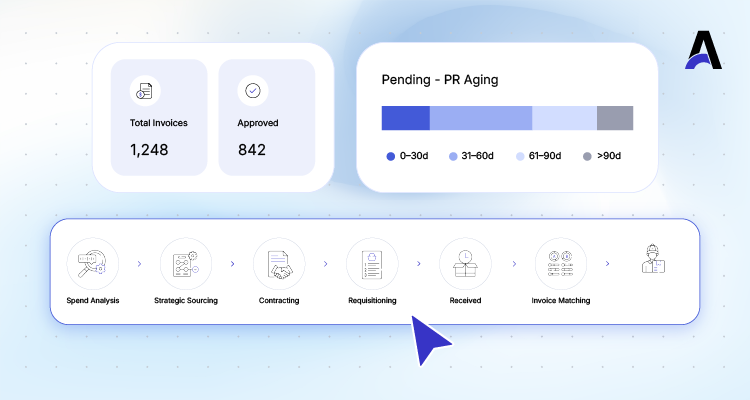
Source-to-Pay, or S2P, is the end-to-end process that connects everything between identifying a business need and paying the supplier who fulfilled it: sourcing, contracting, purchasing, receiving, invoicing and payment, managed as one continuous lifecycle rather than a set of disconnected departmental tasks. For enterprises running high transaction volumes across multiple entities, S2P is less a single piece of software than an operating model, one that a Source-to-Pay platform is built to support end to end.
This guide walks through what S2P actually covers, how it differs from the process pieces most often confused with it, the seven stages every enterprise S2P lifecycle moves through, and where the function is heading: from automating individual tasks toward procurement intelligence that helps teams make better decisions before spending is committed.
Key Takeaways
What Is Source-to-Pay (S2P)?
Source-to-Pay is the complete procurement lifecycle that connects strategic sourcing and supplier selection with the transactional work of purchasing, receiving, invoicing and paying, all managed as one continuous process rather than separate, disconnected activities. The "source" half covers identifying what the business needs, finding and evaluating suppliers, and negotiating terms. The "pay" half covers turning that agreement into purchase orders, receiving goods or services, matching invoices, and settling payment.
The distinction that matters for enterprises is continuity. An organization can automate purchase orders and still run sourcing on spreadsheets or run excellent sourcing events and still lose the negotiated terms the moment a purchase order is raised. S2P, done properly, keeps sourcing decisions, contract terms and supplier data attached to every transaction that follows them, so a negotiated price or compliance requirement does not have to be manually re-entered or rediscovered downstream.
Source-to-Pay vs Procure-to-Pay vs Source-to-Contract
These three terms are often used loosely and interchangeably, which creates real confusion when enterprises scope a technology decision. Each covers a different slice of the same lifecycle.
| Dimension | Source-to-Pay (S2P) | Procure-to-Pay (P2P) | Source-to-Contract (S2C) |
|---|---|---|---|
| Starting point | Identifying a sourcing need | Purchase requisition | Identifying a sourcing need |
| Ending point | Supplier payment | Supplier payment | Signed contract |
| Core activities | Everything in S2C and P2P, connected end to end | Requisition, PO, receiving, invoice, payment | Sourcing, RFx, negotiation, contracting |
| Primary owner | Procurement function as a whole | Procurement operations, accounts payable | Category managers, strategic sourcing |
| Typical gap if used alone | Requires the most connected technology and data model | No upstream sourcing or negotiation context | No visibility once the contract is signed |
Many enterprises already execute core P2P transactions within ERP environments. The challenge is often maintaining continuity between upstream sourcing and supplier decisions and the downstream transactions that follow.
The 8 Stages of the Source-to-Pay Lifecycle
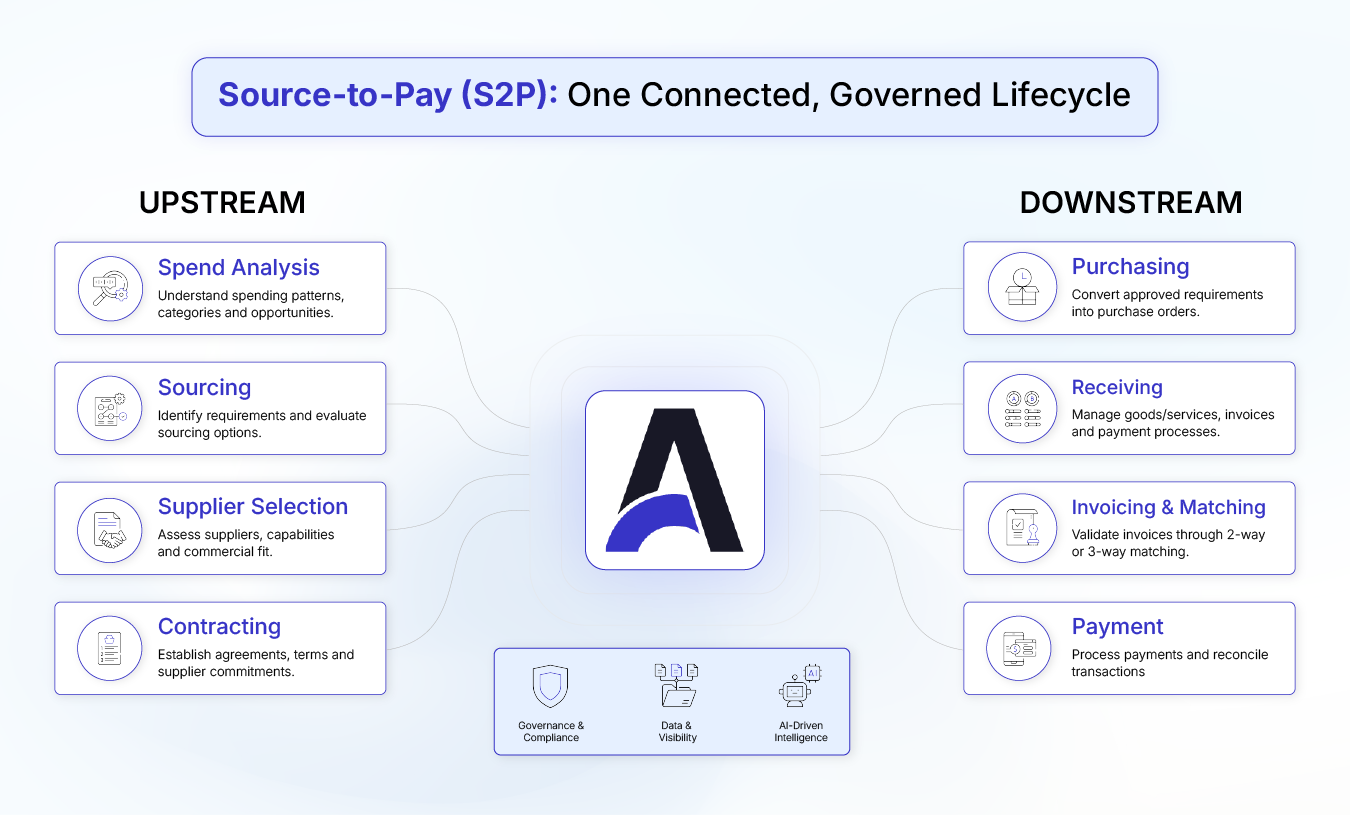
Enterprise Source-to-Pay connects the full procurement lifecycle from understanding spend and selecting suppliers through purchasing, receiving, invoice validation and payment. The first four stages form the upstream procurement process, while the final four form the downstream transaction process. Governance, data visibility and AI-driven intelligence support the entire lifecycle so decisions and controls remain connected from one stage to the next.
- Spend Analysis and Demand Planning. Procurement begins by analyzing historical spend to understand purchasing patterns, categories, suppliers and potential savings opportunities. Clean, classified spend data gives sourcing teams a stronger foundation for planning demand, identifying leakage and deciding where procurement attention is needed.
- Sourcing. Procurement teams define requirements and evaluate available sourcing options through RFx events, competitive bidding, e-auctions and structured negotiations. The objective is to identify the right commercial approach while considering price, quality, capacity, risk and business requirements.
- Supplier Selection. Potential suppliers are assessed against commercial, operational, technical and compliance criteria before an award decision is made. A structured selection process helps enterprises choose suppliers based on overall fit and capability rather than price alone.
- Contracting. Agreed commercial terms are converted into formal supplier contracts covering pricing, service levels, responsibilities, compliance requirements and renewal conditions. Effective contract lifecycle management ensures negotiated commitments remain visible and usable when purchasing begins.
- Purchasing. Approved business requirements move into the transactional procurement process, typically through purchase requisitions, approvals and purchase orders. The objective is to ensure purchases follow approved suppliers, negotiated terms, budgets and enterprise approval policies rather than becoming unmanaged transactions.
- Receiving. Goods and services are formally acknowledged through goods receipts, GRNs or service-entry records. This confirms what was actually delivered and creates the operational evidence required for accurate invoice validation and downstream financial processing.
- Invoicing and Matching. Supplier invoices are validated against purchase orders and receiving records using two-way or three-way matching. This helps identify pricing differences, quantity mismatches, duplicate invoices and other exceptions before an invoice is approved for payment.
- Payment. Once an invoice has been validated and approved, payment is processed according to agreed supplier terms and finance controls. Payment status and transaction records then complete the operational S2P cycle while providing procurement and finance teams with a clear audit trail.
When these stages operate as disconnected activities, procurement teams lose context between sourcing decisions, contracts, orders, receipts, invoices and payments. A connected Source-to-Pay model keeps governance and compliance, data and visibility, and AI-driven intelligence active across the lifecycle, allowing each stage to pass reliable information and control to the next.
From Automation to Procurement Intelligence
Most enterprise S2P investment over the past decade has focused on automation: digitizing requisitions, automating approval routing, and replacing manual three-way matching with system-driven checks. That work is not wasted, but it answers a narrower question than the one procurement leaders are now being asked to answer.
Automation makes an existing task faster and more consistent. It does not, on its own, tell a category manager about which supplier relationship carries emerging risk, or flag that a negotiated saving is quietly eroding because purchase orders are being raised off contract. That is the job of procurement intelligence: using connected data from across the S2P lifecycle, sourcing history, contract terms, supplier performance, spend patterns, to surface risks, exceptions and opportunities before they become a problem, not in a quarterly report after the fact.
Enterprise adoption is already shifting in this direction. A 2026 Ardent Partners survey of 311 CPOs and senior procurement leaders found that 58% are now actively using or piloting AI within their procurement function, with adoption split across an exploratory phase, active piloting and full deployment.¹ The shift is no longer whether to add intelligence to S2P, but how far along that path an organization currently sits.
SAFAL's Procurement Maturity Model
That question, how far along the path an organization sits, is easier to answer with a shared reference point. The progression below builds on the manual-to-intelligent evolution most enterprises already recognize in their own procurement history and extends it with a fifth level that reflects where AI-assisted execution is heading next.
SAFAL Procurement Maturity Model: Five Levels From Manual to Autonomous
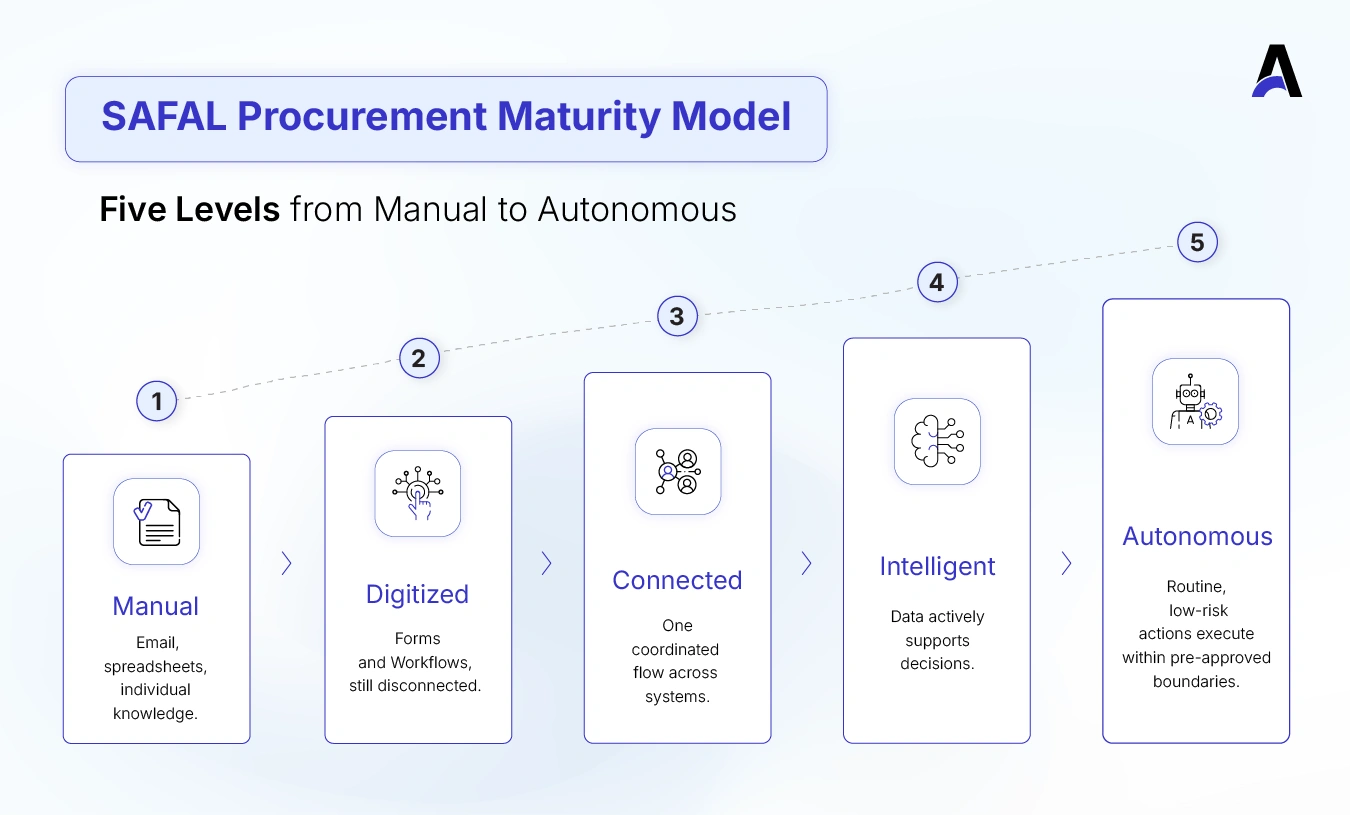
How to use this: Most enterprises are not uniformly at one level. A single organization can be Level 3 in purchase-to-pay and Level 1 in supplier onboarding. The useful exercise is mapping maturity stage by stage across the S2P lifecycle, not assigning one score to the whole function.
This is deliberately not a call to skip levels. An enterprise cannot move to autonomous execution without first having connected, trustworthy data flowing through a coordinated process. Each level is the foundation the next one depends on.
What to Look for in an Enterprise S2P Platform
Rather than a ranked list of vendors, the more durable exercise is evaluating platforms against the principles that determine whether S2P technology delivers value at enterprise scale.
- Connected Architecture. Does the platform extend your existing SAP, Oracle, Microsoft Dynamics or Navision environment through governed, bi-directional integration, or does it require re-entering data that already exists in the ERP?
- Fit-to-Process. Can the platform adapt to the enterprise's operating processes, approval structures, entities, and procurement realities without forcing unnecessary standardization or excessive customization?
- Supplier Participation. Is onboarding and ongoing collaboration built for the supplier, not just the buyer, since low supplier adoption quietly undermines every stage downstream?
- Governance. Can delegation of authority, multi-entity approval rules and policy exceptions be configured without custom development, and do they travel with the request as it moves through the lifecycle?
- Decision Intelligence. Does spend visibility surface exceptions and opportunities while there is time to act, or only summarize what already happened?
- Enterprise Scalability. For conglomerates and multi-region operations, can the platform coordinate procurement across more than one ERP instance without forcing a single rigid workflow on every entity?
These principles matter more than any individual feature checklist, because they determine whether the platform closes the automation-to-intelligence gap described above, or simply adds another disconnected system to reconcile.
Industry Considerations
S2P maturity varies meaningfully by sector. In EPC and infrastructure, sourcing and contracting are tied to project budgets, bill-of-quantities structures and long-lead equipment, which makes the source-to-contract stage disproportionately high-stakes. In oil and gas and chemicals, supplier qualification and HSE compliance documentation add a layer of governance that has to travel with every purchase order, not just live in a separate compliance system. In manufacturing, direct material sourcing and multi-plant purchasing mean spend analysis has to work at a granularity most generic S2P guides do not address. Enterprises in these sectors tend to need deeper sourcing and governance capability earlier in their S2P maturity journey than a services or retail organization of similar size.
SAFAL Insight
Most S2P content stops describing the process. That is useful, but it treats every enterprise as though they are starting from zero and ending at the same finish line: a fully automated, digitized workflow.
In practice, enterprises rarely start from zero, and digitization is not the finish line. An organization can have a fully digitized purchase-to-pay process and still be operating at a lower maturity level than a competitor with a less polished interface but genuinely connected sourcing, contract and spend data. The lifecycle stages describe what S2P covers. The maturity model describes how much value an enterprise is extracting from it, and where the next investment should go.
That is the more useful question for a CPO building a business case: not "which stage are we missing," but "which level are we actually operating at in each stage, and what does the next level require."
Where SAFAL Fits
SAFAL's Source-to-Pay Suite connects all seven stages described in this guide, intake, strategic sourcing, contracting, purchasing, invoicing and supplier performance, inside one governed environment that integrates natively with the ERP systems enterprises already run. Rather than treating each stage as a separate module to buy and reconcile, SAFAL is built around the principle that sourcing decisions, contract terms and supplier data should travel automatically with every transaction that follows them.
That architecture is also what makes progress the maturity model achievable in stages rather than as a single high-risk transformation. SAFAL enables enterprises to modernize Source-to-Pay progressively, prioritizing the processes where fragmentation, governance gaps or limited decision visibility create the greatest business impact. The objective is not to replace the ERP, but to connect procurement decisions and execution around the enterprise systems already in place.
Conclusion
Source-to-Pay is not a single piece of software or a single project. It is the connected lifecycle that turns a sourcing decision into a paid, performance-tracked supplier relationship, and the enterprises getting the most value from it are the ones treating maturity as a stage-by-stage journey rather than a one-time implementation
The practical next step is not choosing a platform. It is mapping where each of the seven stages actually sits today, manual, digitized, connected, intelligent or autonomous, and being honest that most organizations will find a different answer for sourcing than they do for invoicing. That map is what turns this guide from background reading into a working plan.
Explore how SAFAL’s Source-to-Pay platform connects all seven stages, or book a demo to map your organization’s current maturity level with the SAFAL team.
Frequently Asked Questions

Nikunj Soni
Nikunj Soni is Product Operations & Delivery Head at SAFAL, with 9 years of professional experience and a strong focus on product operations and enterprise solution delivery.