


























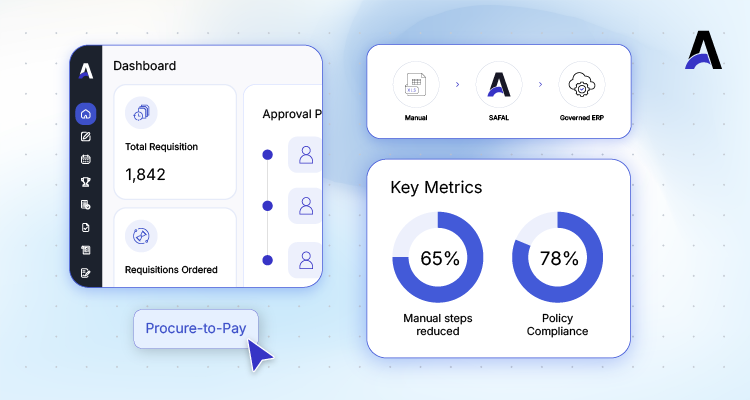
Procure-to-Pay, or P2P, is the process that turns an approved business need into a paid supplier invoice: requisition, approval, purchase order, receiving, invoice matching and payment. Many enterprises have already digitized parts of the Procure-to-Pay process through ERP modules or procurement platforms. But digitization alone is not the same as procurement excellence. Moving requisitions, approvals and invoices online does not automatically resolve disconnected data, inefficient approvals or limited visibility across the process.
This guide explains what P2P covers, its core stages, and the digital-versus-excellent gap that shows once the forms are online, but the outcomes have not improved. It closes with a short, honest self-assessment: five questions that reveal whether an organization's P2P process is genuinely mature or simply digitized.
Key Takeaways
What Is Procure-to-Pay (P2P)?
Procure-to-Pay is the operational process that converts an approved purchase requisition into a completed, paid transaction: requisitioning, approval, purchase order creation, receiving, invoice matching and payment. It is transactional by design, focused on executing a purchase efficiently, accurately, and in compliance with policy, rather than on deciding which supplier to use or what price to negotiate.
P2P is usually the first procurement process enterprises digitize, because it sits closest to the ERP and has the clearest, most repeatable workflow of any procurement activity. That makes it the natural starting point for automation investment, and also the process most likely to be mistaken as "done" once a digital form replaces a paper one.
Procure-to-Pay vs Source-to-Pay
The Stages of the P2P Process
1. Requisitioning. A business need is formally documented, typically through a purchase requisition, specifying what is needed, why, and against which budget or category.
2. Approval. The requisition routes through approval based on value, category and delegation of authority, ideally against a policy-aware workflow rather than a manual email chain.
3. Purchase Order Creation. Once approved, the requisition becomes a purchase order, ideally generated against an existing contract or catalog rather than a fresh, unmanaged transaction.
4. Order Fulfillment and Receiving. The supplier delivers the goods or service, and the receiving team confirms what was received through a goods receipt note or service entry. Creating the record invoice matching depends on.
5. Invoice Matching. The supplier invoice is checked against the purchase order and goods receipt through two-way or three-way matching before it is approved for payment, the control point that catches pricing discrepancies and unauthorized substitutions.
6. Payment. The approved invoice is settled according to agreed terms, ideally capturing any early-payment discounts and maintaining the audit trail finance needs for reconciliation.
7. Record-Keeping and Reporting. Completed transactions feed spend data back into reporting, informing budget tracking, supplier performance and the next cycle of sourcing decisions.
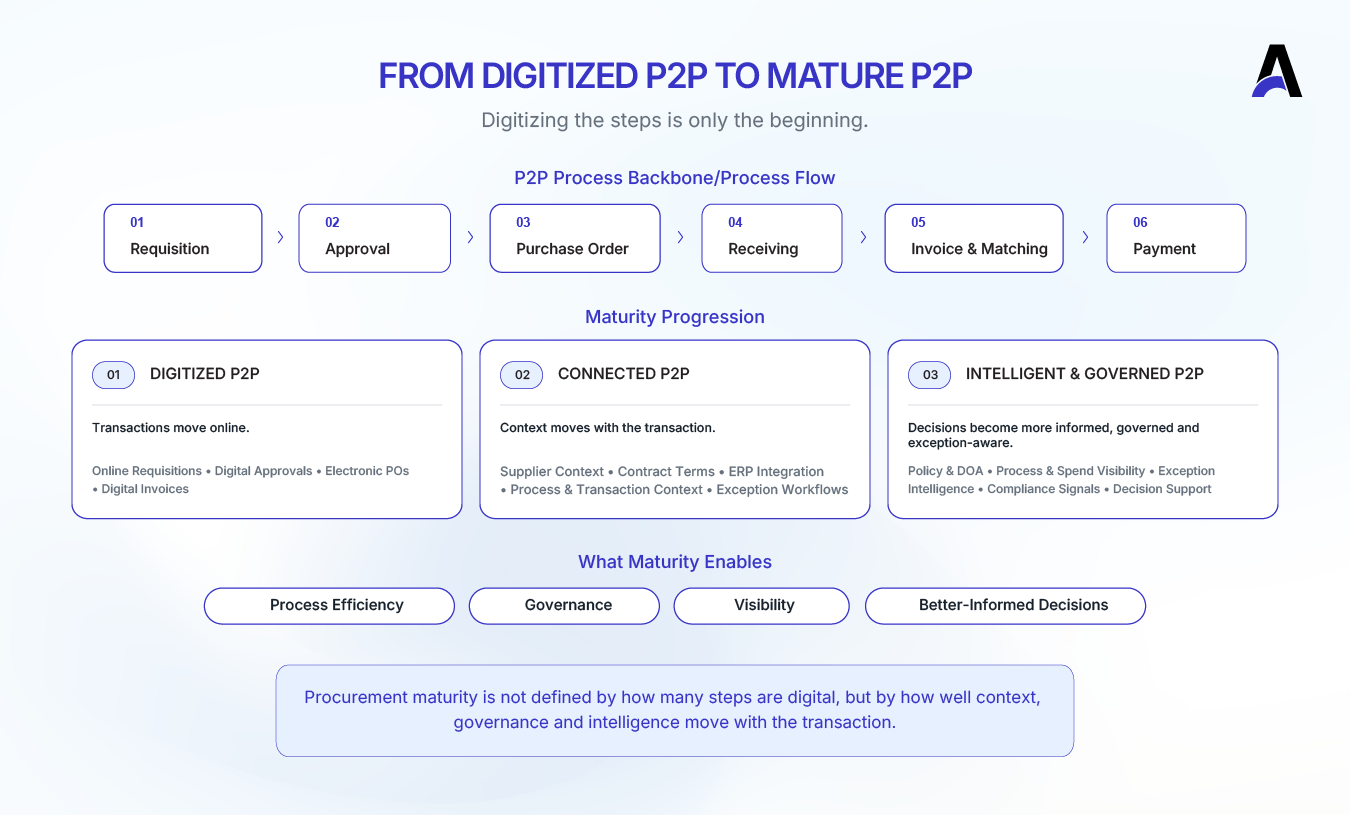
Each stage is straightforward in isolation. The excellence gap, and the reason this guide exists, shows how well these stages connect to one another, not whether each one individually has been digitized.
Why Digital Processes Alone Don't Deliver Procurement Excellence
Replacing a paper requisition form with a digital one is a real improvement. It is also a much smaller improvement than most enterprises assume, because digitizing a step does not automatically fix what was wrong with it. A slow, unclear approval chain becomes a slow, unclear digital approval chain. A disconnected purchase order process becomes a disconnected digital one. The paperwork moved online; the underlying coordination problem did not.
The gap is measurable. APQC’s Open Standards Benchmarking research on touchless order performance found that top-performing organizations process 94% of orders without any human intervention, while bottom performers require manual handling on 20% or more of orders, despite most organizations in both groups running comparable, digitized P2P systems. 1 The difference between those two outcomes is not whether the process is digital. It is whether the process is connected: whether approvals, catalogs, contracts and supplier data flow together, or whether digitization simply moved the same disconnected handoffs onto a screen.
This is the same distinction that separates automation from intelligence across the wider procurement lifecycle: automation makes an existing task faster, while genuine maturity comes from connecting the data and context around that task so exceptions get caught, approvals route correctly the first time and spend stays visible in real time rather than in a report produced after the fact.
SAFAL P2P Health Check: 5 Questions Worth Asking.
Rather than simply asking whether your P2P process is digitized, the SAFAL Procurement Health Score looks at how well your procurement operation performs against relevant industry benchmarks. Take a few minutes to answer the five questions below honestly and gain a clearer view of your procurement maturity, performance gaps, and opportunities for improvement.
Five questions that reveal whether P2P execution is connected to the wider procurement environment.
1. What is your average approval cycle time and where do delays occur?
Healthy organizations resolve most standard approvals within a day or two. If approvals routinely stretch into a week, the workflow logic, not the volume of requests, is usually the bottleneck.
2. How long does supplier onboarding take?
Slow onboarding delays every transaction with a new supplier and often signals manual document collection and verification rather than a structured, self-service process.
3. How much spend is visible in real time?
If spend visibility means waiting for a monthly or quarterly report, exceptions and maverick purchasing are being discovered weeks after they happened, not while there is still time to act.
4. What is your contract compliance rate?
A low share of spending running against negotiated contracts means sourcing savings are being negotiated and then quietly lost at the purchase order stage.
5. What percentage of purchase orders are touchless?
Industry benchmarking puts top performers at roughly 90% or higher, with typical organizations closer to two-thirds and bottom performers requiring manual handling one in five orders or more.
How to use this: None of these questions has a single passing score, and few organizations will answer all five well. The value is in the honesty of the answer: any question answered with "we don’t actually know" is itself the finding and usually points to a visibility gap rather than a technology gap.
P2P Principles for Enterprise Procurement
1. Keep every approval inside the workflow.
Exceptions should follow the same policy-aware workflow as standard requests, with approvals mapped to actual delegation of authority and multi-entity policies. This preserves the audit trail, prevents side-channel approvals and keeps cycle times predictable.
2. Make contracts and catalogs the default path to purchase.
Every requisition should start with pre-approved catalogs and negotiated contracts. Off-contract purchasing should be a visible, justified exception, so negotiated pricing and supplier terms consistently translate into realized savings.
3. Automate the routine and escalate only exceptions.
Three-way matching should automatically validate standard purchase orders, receipts and invoices. Only genuine discrepancies, such as price variances, quantity mismatches or missing receipts, should require human review.
4. Make supplier participation part of the workflow
A self-service supplier portal should handle onboarding, document collection, order acknowledgments and invoice submission. Automated verification and structured data capture reduce delays and prevent suppliers from recreating manual processes outside the system.
5. Give procurement visibility while there is still time to act.
Real-time P2P dashboards should surface maverick spend, budget overruns and other exceptions as they occur, rather than relying on monthly or quarterly reports that only explain what has already happened.
6. Connect transactions to sourcing and contract intelligence.
P2P should not end at the ERP general ledger. Sourcing decisions, negotiated pricing, contract terms and supplier obligations should flow into every transaction, creating a connected process from sourcing through purchasing and payment.
Industry Considerations
P2P bottlenecks concentrate differently by sector. In EPC and infrastructure, purchase orders tied to project milestones and long-lead equipment make approval of routing and budget control the highest-risk stage. In oil and gas and chemicals, receiving and invoice matching carry added weight because goods receipt often has to confirm compliance documentation alongside quantity and quality. In manufacturing, touchless processing matters most for high-volume direct material purchase orders, where manual handling at scale creates the largest cumulative delay.
SAFAL Insight
Most P2P content treats digitization and maturity as the same thing. They are not. An enterprise can have a fully digital requisition-to-payment workflow and still fail every question in the health score above, slow approvals, slow onboarding, delayed visibility, low contract compliance, low touchless rates, because the individual steps were digitized without connecting the data and context that make them fast and accurate.
Closing this gap typically requires more than adding another isolated P2P feature. It requires connecting requisitions, approvals, contracts and supplier context so downstream execution retains the information and governance established upstream.
Where SAFAL Fits
SAFAL approaches Procure-to-Pay as part of a connected procurement environment rather than an isolated transactional workflow. Requisitions, approvals, purchase orders, receiving and invoice processes can remain connected to the supplier, sourcing and commercial context established upstream, while integrating with the ERP environment that remains central to enterprise transaction processing.
The objective is not simply to digitize each P2P stage. It is to preserve governance, context and visibility as transactions move from business request through payment, while allowing standard activities to flow efficiently and bringing exceptions to the right people for review.
For enterprises evaluating P2P maturity, the useful question is therefore not only “Is the process digital?” but “How much context and governance survives as the transaction moves through it?”
Conclusion
Procure-to-Pay is often the first procurement process enterprises digitize, and the easiest one to mistake as finished once it is. The five-question health score in this guide is a faster, more honest test than any feature list:
An enterprise that cannot answer these questions with confidence has identified something important: either a visibility gap, a process gap, a governance gap or a connection gap worth examining.
The practical next step is running the assessment honestly, stage by stage, and treating any "we don’t know" answer as the actual starting point for the next investment decision.
See how SAFAL’s Procure-to-Pay platform connects requisitioning through payment, or book a demo to walk through your own procurement health score with the SAFAL team.
Frequently Asked Questions

Nikunj Soni
Nikunj Soni is Product Operations & Delivery Head at SAFAL, with 9 years of professional experience and a strong focus on product operations and enterprise solution delivery.