


























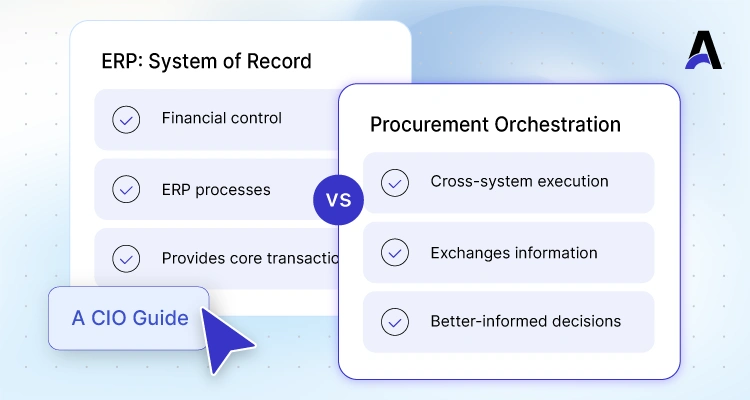
Why enterprises need procurement orchestration, governance and intelligence across the ERP systems they already have, rather than simply adding another system of record.
Enterprise procurement rarely breaks because one system cannot process a transaction. More often, friction appears in the space between systems, stakeholders, policies and decisions.
ERP remains essential for master data, transactions and financial control. But procurement begins before a transaction is posted, and many of its most important decisions happen across sourcing, suppliers, approvals, contracts, budgets, risk and cross-functional teams.
The strategic question is therefore not simply whether the ERP can do more. It is whether the enterprise has enough connected context, governance and intelligence around the ERP to make and execute better procurement decisions.
That is where procurement orchestration becomes important, not as an ERP replacement, but as part of the foundation for intelligent procurement.
Key Takeaways
Procurement Intelligence Requires More Than AI
Procurement intelligence uses connected procurement data, context, analytics and AI-assisted insights to help teams identify risks, exceptions, opportunities and actions before procurement decisions move into execution.
AI is changing what enterprises expect from procurement technology. But adding AI to fragmented processes does not automatically create intelligent procurement.
For intelligence to influence real procurement decisions, it needs context: What is being purchased? From whom? Under which contract? At what historical price? Through which approval path? Against which policy, budget and supplier history?
That context rarely exists in one place. It sits across ERP, sourcing, supplier data, contracts, approvals, transactions and historical procurement activity.
This is why the next evolution of enterprise procurement is not simply more automation. It is connected intelligence embedded into the flow of procurement itself.
AI can identify patterns, surface exceptions, highlight opportunities and recommend actions, but those recommendations must operate within enterprise policy and governance.
The objective is not AI making procurement decisions. It is giving procurement teams better intelligence at the moment those decisions are made.
And that requires something underneath the intelligence: connected procurement processes.
Why ERP-Led Procurement Can Still Leave Gaps
ERP remains the backbone of enterprise operations, managing master data, purchase transactions, receipts, invoices, accounting and financial controls.
But procurement does not begin when a purchase order is created.
Before a transaction reaches ERP, a business need may move through budget checks, sourcing, supplier qualification, technical and commercial evaluation, approvals, contract terms and cross-functional reviews. In complex enterprises, these steps can span multiple entities, locations, teams and systems.
The gap appears when these activities are digitized, but not connected.
The ERP may be working exactly as intended while procurement around it still relies on disconnected workflows and manual handoffs.
Common signs include:
- requests and approvals moving through email, chat or spreadsheets;
- sourcing decisions disconnected from downstream purchasing;
- supplier information and documents scattered across systems;
- negotiated terms manually transferred into transactions;
- limited visibility before spend becomes an ERP transaction; and
- incomplete decision history when audit evidence is required.
These are not necessarily ERP capability problems. Modern ERP platforms can support procurement transactions and configurable approval workflows. The gap often appears when procurement activity needs to remain connected across multiple systems, suppliers, stakeholders and policies. In those situations, the process surrounding the ERP may need better orchestration, governance and visibility.
What Is Procurement Orchestration?
Procurement orchestration coordinates processes, stakeholders, policies, data and systems so a procurement need can move through the appropriate path from request to execution.
It does not need to replace the ERP or own the general ledger. Its role is to connect the work that happens across procurement, finance, legal, operations, suppliers and enterprise applications while allowing each system to retain its appropriate role.
In practice, orchestration connects context, routing, cross-functional handoffs, system integration, exceptions and visibility into one governed flow.
Digitization makes an activity digital. Orchestration connects that activity to the decisions, controls, stakeholders and downstream actions it depends on.
ERP vs Procurement Orchestration
ERP and procurement orchestration solve different architectural problems and should not automatically be treated as competing technologies.
| Dimension | ERP: System of Record | Procurement Orchestration |
|---|---|---|
| Primary role | Authoritative enterprise transactions and financial control | Coordination across procurement processes, people, policies and systems |
| Core strength | Master data, transactions, accounting and financial integrity | Context, continuity, routing and cross-system execution |
| Workflow scope | Manages supported and configured ERP processes | Connects procurement activity spanning functions and applications |
| Data responsibility | Owns authoritative financial and transactional records | Uses and exchanges relevant information while preserving system ownership |
| Governance role | Provides core transactional and financial controls | Carries policy, approvals, exceptions and decision context through execution |
| Primary outcome | Reliable transaction processing and control | Connected execution and better-informed procurement decisions |
The distinction can be summarized simply:
ERP records and controls the transaction. Procurement orchestration connects the decisions and execution around it.
That is why orchestration does not need to replace the ERP to add value. Its purpose is to create continuity around the systems an enterprise already relies on.
Is It an ERP Gap or an Orchestration Gap?
When procurement performance is poor, the first question should not be whether the ERP needs to be replaced.
It should be where the problem actually sits.
If the challenge is core transaction processing, financial controls, master data, security or scalability, ERP modernization may be appropriate.
But when the challenge is fragmented workflows, slow approvals, disconnected sourcing, supplier collaboration, limited visibility or inconsistent policy execution, the gap may exist around the ERP rather than within it.
The more useful question is:
Are we trying to solve a system-of-record problem or a system-of-orchestration problem?
Making that distinction early can prevent enterprises from solving a procurement coordination problem with a much larger ERP transformation.
The SAFAL Intelligent Procurement Framework
Procurement intelligence is not created by adding AI to disconnected workflows. It starts by connecting four capabilities that determine how procurement decisions are made and executed.
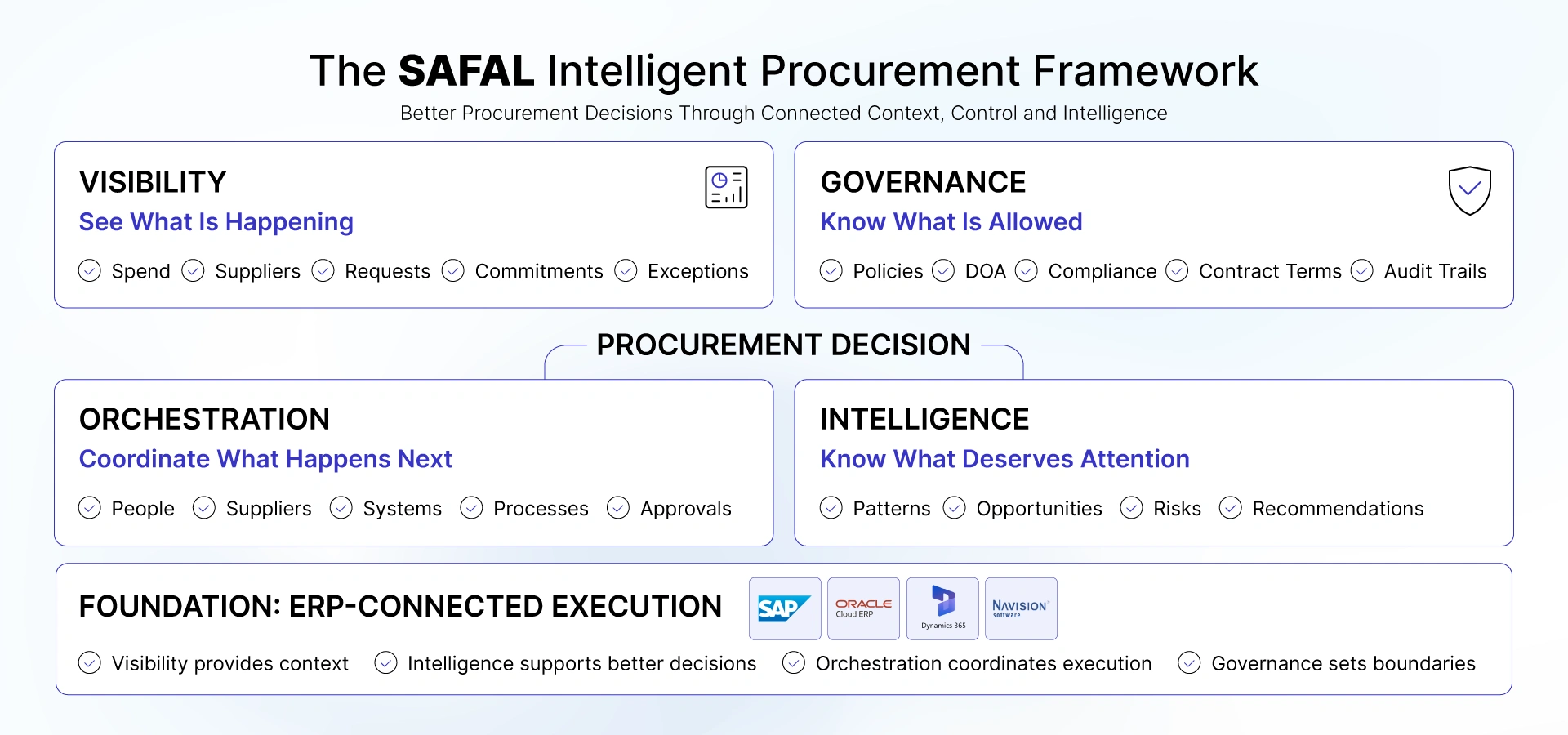
The ERP remains the system of record. SAFAL connects the decisions and execution around it through ERP-connected procurement integrations.
The framework also clarifies why procurement intelligence cannot be separated from governance.
A recommendation may suggest a commercial opportunity, identify unusual pricing or surface a supplier-related exception. But enterprise procurement still needs to determine whether the recommended action fits policy, approval authority, contractual obligations and business priorities.
Intelligence therefore becomes most useful when it participates in a governed process rather than operating as a separate layer of analysis.
How Enterprises Are Evolving Procurement Architecture
Enterprise procurement architecture is increasingly separating systems that hold authoritative records from systems that coordinate work around those records.
This becomes particularly relevant in multi-entity and multi-ERP organizations.
Mergers, acquisitions, regional expansion and decentralized operating models can leave enterprises with multiple ERP environments. Even companies using the same ERP family may operate different instances, configurations or local processes across business units.
Waiting for complete ERP consolidation before improving procurement can delay transformation significantly.
An orchestration layer can provide a more consistent procurement experience, governance model and visibility while underlying ERP systems continue performing their transactional roles.
This creates a different architectural path.
Instead of making procurement transformation dependent on replacing or consolidating every system first, the organization can improve how processes and decisions operate across the existing environment.
This becomes particularly important in complex procurement environments where processes may involve multiple entities, locations, project budgets, CAPEX and OPEX controls, supplier qualification, technical and commercial evaluation, and multi-level approval authority.
In these environments, the challenge is not simply digitizing a request. It is maintaining context, governance and continuity from requirement through execution.
What Should Enterprises Evaluate Before Adding Another Procurement Layer?
Adding another procurement application is not automatically an improvement.
A new layer should strengthen the enterprise architecture rather than create another place where data, decisions and workflows become disconnected.
Four questions can help CIOs, CPOs and procurement transformation leaders evaluate the architecture.
1. Does It Work With the Existing ERP Ecosystem?
The objective should be to extend the enterprise architecture, not create another disconnected system.
Understand what remains authoritative in ERP, what information needs to move between systems, and how procurement execution stays synchronized.
The orchestration layer should work with the technology environment already in place while respecting clear data and transaction ownership.
2. Can It Support the Way the Enterprise Actually Operates?
Procurement varies across entities, locations, categories, spend thresholds and risk levels.
The architecture should adapt to those realities without forcing every requirement into a rigid standardized workflow.
The underlying principle is important:
Does the platform fit the enterprise, or does the enterprise have to fit the platform?
Standardization remains valuable where it strengthens governance and execution. But legitimate differences across business units, entities and operating models also need to be supported.
The objective should be to align technology with how the business needs to operate without introducing another layer of process rigidity.
3. Does It Strengthen Governance While Allowing Procurement to Evolve?
Enterprises need flexibility without losing control.
Approval authority, policy, exceptions, segregation of duties and auditability should remain embedded in execution as processes evolve.
Governance should therefore not operate as a separate layer that employees need to remember after the workflow has already been designed.
Relevant controls should travel with the procurement process.
This enables procurement to change how work is executed while preserving the rules that make those decisions traceable and defensible.
4. Does It Create Better Intelligence or Simply Another Interface?
A new procurement layer should do more than digitize requests and approvals.
It should connect enough context across workflows, suppliers, contracts, transactions and ERP data to help teams identify exceptions, risks, opportunities and decisions requiring attention.
This is an important distinction.
A modern interface may make procurement easier to use.
Connected procurement intelligence should make procurement easier to understand and act on.
That is ultimately a more strategic test of whether another technology layer adds real value.
Where SAFAL Fits
SAFAL is built around a clear architectural principle:
Your ERP is the System of Record. SAFAL is the System of Orchestration.
SAFAL sits between enterprise procurement intent and ERP execution.
It connects sourcing, suppliers, approvals, commercial decisions and downstream transactions through a governed orchestration layer while allowing the ERP to remain the authoritative system of record.
Unlike an additional point solution, SAFAL connects the procurement journey across Source-to-Pay.
And unlike ERP replacement, it is designed to work with the enterprise technology landscape already in place.
With SAFAL 2.0, that connected foundation becomes the basis for something further: procurement intelligence embedded directly into execution.
The distinction matters because SAFAL's role is not to recreate the ERP in another application.
Its role is to help connect the context, governance, stakeholders and decisions that surround enterprise procurement execution.
That allows procurement intelligence to participate in the workflow rather than remain isolated in reports or dashboards after the transaction has already occurred.
From Digitized Procurement to Intelligent Procurement
Digitization can replace email with a form, a spreadsheet with a dashboard, or a manual approval with a digital workflow.
Those changes improve execution, but they do not automatically create intelligence.
The next step is to connect context with decisions.
When procurement data, supplier activity, contracts, approvals and ERP transactions are connected, teams can begin to see more than process status.
They can identify where spend is flowing, where commercial outcomes differ, where contract or policy exceptions exist, where supplier patterns deserve attention and where savings or risk opportunities may be emerging.
The evolution can be understood simply:
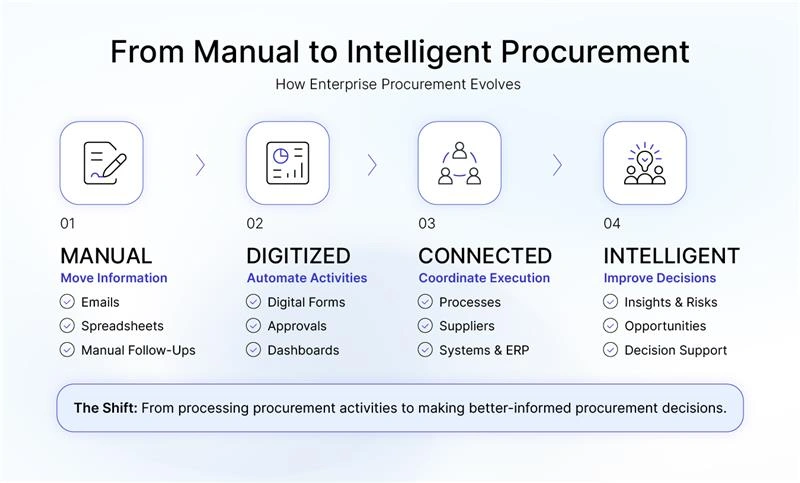
Manual Procurement
Processes depend heavily on email, spreadsheets, individual knowledge and manual follow-up.
The challenge is not only inefficiency. Decision context often sits with individual people rather than within a traceable process.
Digitized Procurement
Forms, dashboards, approval workflows and online supplier interactions replace some manual activities.
Execution becomes easier to track, but individual digital processes may still remain disconnected from one another.
Connected Procurement
Requests, sourcing, suppliers, contracts, approvals and ERP transactions begin operating as part of a coordinated flow.
Context is preserved as procurement moves from one stage to another.
Intelligent Procurement
Connected information begins supporting better decisions.
Procurement teams can identify patterns, exceptions, opportunities and risks without manually reconstructing the full context from different systems.
This changes the role of procurement technology.
The objective is no longer only to make individual activities faster.
It is to improve what the enterprise can understand before an important procurement decision is made.
Human judgment remains central.
Commercial negotiations, strategic supplier decisions, policy exceptions and material risk decisions still require accountability and business judgment.
Intelligence should therefore support the decision-maker rather than attempt to remove the decision-maker from the process.
That is the progression from digitizing procurement activity to creating a more intelligent procurement operating model.
Conclusion
ERP and procurement orchestration solve different architectural problems.
ERP remains essential for authoritative transactions and financial control. Orchestration becomes relevant when procurement decisions and execution are fragmented across systems, stakeholders, suppliers and policies.
But orchestration is not the final destination.
The larger opportunity is intelligent procurement: connected context, embedded governance and decision support operating around the enterprise systems already in place.
The question for procurement and technology leaders is therefore not simply:
"Do we need another platform?"
It is:
"Do we have the visibility, governance, orchestration and intelligence required to make better procurement decisions before they become transactions?"
Frequently Asked Questions

Mohammad Ali Holda
Mohammad Ali Holda has built SAFAL's enterprise client portfolio across India and the GCC through a consultative, environment-first approach.