































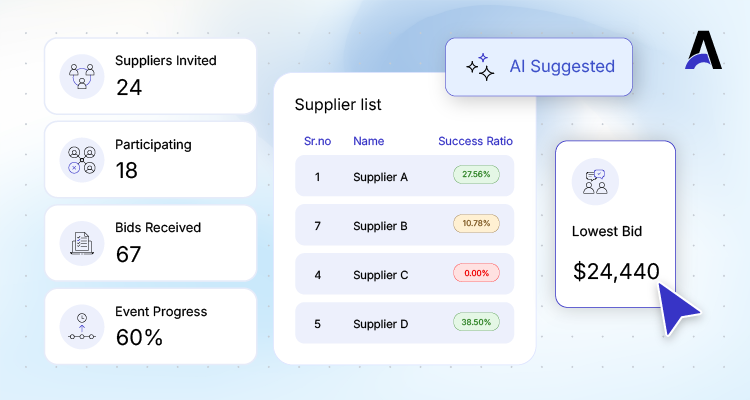
E-sourcing tools are software platforms used to plan and run digital sourcing events, including RFI, RFQ, RFP, tenders, negotiations and e-auctions, with structured supplier participation, bid evaluation and award workflows. Enterprises should compare e-sourcing platforms against their own sourcing scenarios, ERP environment, supplier base and governance requirements rather than relying on feature checklists alone. This guide gives procurement heads, category managers and CIOs a weighted framework for comparing eSourcing software, plus a checklist for proving it in a demo. For context on how SAFAL approaches the category, see its e-sourcing solution.
Key Takeaways
What Are E-Sourcing Tools?
E-sourcing tools are digital platforms that manage the sourcing process between a buyer and its suppliers, from supplier invitation and bid submission to evaluation, negotiation and award. They replace email, spreadsheets and shared folders with structured events, rules and a record of every action.
The terms e-sourcing tools, eSourcing software, e-sourcing platforms and e-sourcing solutions are commonly used for the same software category.
- E-procurement covers requisition, ordering and receiving of goods and services. E-sourcing comes before it, when the supplier and price are still being decided.
- E-auctions are one event type inside e-sourcing, used when price competition between qualified suppliers is appropriate.
- Source-to-Contract and Source-to-Pay extend sourcing into contracts, purchase orders and payment.
What Should E-Sourcing Software Be Able to Do?
Enterprise e-sourcing software should support the full sourcing event lifecycle: event creation, supplier participation, structured bid collection, technical and commercial evaluation, negotiation, award approval and auditability.
| Capability | What to test in a demo |
|---|---|
| Event types | Can the platform run RFI, RFQ, RFP and tender events, including multi-round events, from reusable templates? |
| Supplier invitation and clarification | Do all bidders see the same clarifications at the same time, and are deadlines and reminders automatic? |
| Bid collection | Are bids captured against a template, validated, and normalised for unit and currency? |
| Evaluation and scoring | Can technical and commercial bids be scored separately, with weighted criteria and landed cost? |
| Negotiation and auctions | Which auction formats and rules are supported, and can the buyer pause or extend a live event? |
| Award and handoff | Does the award record scores, rationale and approvals, and does it flow into contract or PO creation? |
| Audit trail and analytics | Is every action time-stamped and attributed, and can you report cycle time, participation and savings? |
How Does an E-Sourcing Event Work?
An e-sourcing event follows a repeatable sequence from event design to award. Knowing the sequence helps you judge whether a platform supports each step or leaves it to email.
- Design the event. Choose the event type, scope, specifications, evaluation criteria and weights, and timeline.
- Invite suppliers. Send invitations with documents and deadlines, and record which suppliers confirm participation.
- Manage clarifications. Answer supplier questions in one place so every bidder sees the same information.
- Collect bids. Receive bids against a template, validate mandatory fields and normalise units and currencies.
- Evaluate and negotiate. Score technical and commercial responses, run further rounds or an auction if appropriate, and compare landed cost.
- Award and hand off. Record the recommendation, approvals and rationale, notify suppliers and pass the result to contract or purchase order creation.
The first and last steps are where many programmes fail. Poor event design produces bids that cannot be compared, and a weak handoff lets the awarded price disappear between the event and the order.
What Types of E-Sourcing Platforms Are Available?
E-sourcing platforms fall into four broad categories: ERP-native sourcing modules, specialist e-sourcing tools, Source-to-Pay suites and orchestration layers that connect to an existing ERP. Each has a different strength and a different risk.
| Category | Typical strength | Typical consideration |
|---|---|---|
| ERP-native sourcing module | Close alignment with ERP master data and transactions | Depth of sourcing functions and supplier experience varies; usually tied to that ERP |
| Specialist e-sourcing tool | Focused event and auction functionality | Downstream contract, PO and ERP handoff may need separate integration |
| Source-to-Pay suite | Sourcing connected to contracts, POs, invoices and analytics | Broader scope can mean a longer rollout if all modules are adopted at once |
| Orchestration layer over the ERP | Works across several ERPs and keeps the ERP as system of record | Needs clear data ownership and integration design |
Enterprises usually meet vendors from every category on one shortlist, and a vendor list is not a ranking. Decide which category fits your ERP landscape and sourcing volume before comparing names. For the wider decision, see SAFAL's procurement software selection framework.
Why Do "Best E-Sourcing Software" Lists Mislead Buyers?
Lists of the best e-sourcing software mislead when they give no methodology, mix categories and repeat market or savings figures without a named source. A top-ten list that compares an ERP suite with a bidding tool on the same two columns tells a buyer very little. Treat any list as a starting point for your own shortlist, and apply the weighted framework below to every name on it.
How Should Enterprises Compare E-Sourcing Platforms?
Compare platforms with a weighted scorecard built from eight criteria. Set the weights before vendor demos, score each platform from evidence you witnessed, and keep the notes for the audit trail of your own selection decision.
| Criterion | Key question | Evidence to request |
|---|---|---|
| Process coverage | Does it cover your event types and categories, including technical bids? | Live run of your own RFQ or RFP template |
| Evaluation and scoring | Can it separate technical and commercial evaluation with weighted scoring? | Sample scoring sheet and award recommendation |
| Auctions and negotiation | Which formats, rules and controls are configurable? | Mock auction with decrement and extension rules |
| Supplier experience | How easy is it for a first-time supplier to respond? | Supplier-side walkthrough and onboarding steps |
| ERP and downstream integration | Do results reach supplier master, contract and PO in your ERP? | Integration design for your ERP and entity structure |
| Governance and audit | Is every action recorded with time and user, with role-based access? | Audit log sample and role configuration |
| Security and compliance | What certifications and controls apply to your data? | Certification documents and security questionnaire answers |
| Implementation and total cost | What does rollout need, and what are all recurring costs? | Scope, resourcing plan and itemised commercial proposal |
What Should an E-Sourcing Strategy Define Before You Buy?
An e-sourcing strategy defines which categories go through events, which event type applies, who owns each event and what rules govern bidding. Software cannot decide these for you, and unclear rules produce inconsistent events on any platform.
Start with a simple decision guide for event types:
| Event | Use it when | Watch-out |
|---|---|---|
| RFI | You need to learn about the market or qualify suppliers | Not a price request, so avoid treating answers as offers |
| RFQ | Specifications are fixed and price is the main variable | Comparable only if every bidder quotes against the same specification |
| RFP | The solution, scope or approach differs between suppliers | Needs weighted scoring criteria agreed before bids arrive |
| Tender | Rules or regulations require a formal, sealed process | Needs strict deadlines, access controls and audit trail |
| E-auction | Specifications are firm and qualified suppliers compete on price | Over-use can strain supplier relationships on complex items |
Add sourcing thresholds by value and category, standard templates, a supplier enablement plan and a post-event review step. The UNCITRAL Model Law on Public Procurement is written for public buyers, but its stated goals of objectivity, fairness, participation, competition, integrity and transparency are a useful test for private sourcing rules as well.
Why Do ERP Integration and Award Continuity Matter?
A sourcing event creates value only if the awarded price, supplier and terms reach the purchase order. When results are copied manually into contracts or POs, savings leak through re-keying errors and off-contract buying.
SAFAL states that e-Sourcing integrates natively with SAP, Oracle, Microsoft Dynamics and Navision, and that sourcing outcomes flow into the ERP for supplier master updates, contract posting and PO creation. Its integrations and APIs page describes bi-directional connectors and entity-based routing of financial postings. In your own evaluation, ask any vendor to show the same chain with your ERP: award, supplier record, contract and PO.
Ask three further questions. Who owns supplier master data? What happens when a sync fails? How does the platform handle several ERP instances or legal entities?
Which Security and Governance Evidence Should You Request?
Request evidence rather than badges. ISO describes ISO/IEC 27001 as "the internationally recognized standard for establishing, implementing, maintaining, and continually improving" an information security management system, and notes that certification is voluntary but often sought to assure customers. Ask for the certificate, its scope and its validity date, and confirm that the scope covers the product you will use.
Also check role-based access, segregation of duties between event creators and approvers, sealed-bid controls that prevent early access to bids, and a complete, time-stamped log of invitations, clarifications, bids, scores and award decisions. These controls protect both the buyer and the integrity of the process.
How Does Supplier Experience Affect E-Sourcing Results?
Supplier experience affects results because a platform that suppliers find hard to use produces fewer, weaker and later bids. Buyers often score their own screens and forget that the supplier side decides participation.
Evaluate the supplier journey as carefully as the buyer journey:
- How does a supplier register or accept an invitation, and does it need training?
- Can suppliers see rules, deadlines and documents clearly, and receive reminders?
- Are there practice sessions or readiness checks before a live auction?
- Is the bid template simple enough for small suppliers to complete without errors?
- Does the platform reuse supplier information already collected during onboarding?
Plan supplier enablement as part of the rollout. Brief key suppliers on the new process, explain what changes and what does not, and offer a contact for support during their first events.
How Do You Prove an E-Sourcing Platform Before Buying?
Replace scripted demos with a proof run using your own data. A short, structured trial reveals more than any feature list.
- Run one real RFQ with your own item list, units, currencies and three to five supplier contacts.
- Run one technical and commercial RFP with weighted criteria and at least two evaluators.
- Run a mock auction with your decrement rules, reserve price and time extension.
- Award the event and show the contract and PO created in your ERP or test environment.
- Ask a supplier who has never used the platform to respond, and note what help they needed.
- Pull the audit log and event report for the run.
What Does an E-Sourcing Solution Really Cost?
Total cost goes beyond the licence. Compare platforms on the same cost components so quotes are comparable, and be cautious with any vendor savings claim that is not tied to a named, verifiable source.
- Licence or subscription model, and what triggers price changes (users, events, spend or modules).
- Implementation and configuration effort, including templates and approval workflows.
- ERP integration build and ongoing support.
- Data preparation, including supplier master clean-up.
- Training for buyers, evaluators and suppliers.
- Internal time from procurement, IT and finance.
What Mistakes Do Enterprises Make When Choosing and Rolling Out E-Sourcing Software?
Five mistakes appear repeatedly, and each is avoidable with a decision made before selection.
- Choosing on the demo, not on the scenario. Scripted demos hide gaps in technical evaluation, multi-entity setups and ERP handoff.
- Starting with auctions. Teams that begin with price-only events can damage supplier relationships and miss complex categories.
- Skipping templates. Without standard event templates, every event is built from scratch and comparison across events is impossible.
- Ignoring supplier master data. Duplicate or incomplete supplier records slow invitations and cause errors at award.
- Rolling out all categories at once. A phased rollout by category or entity lets the team fix process issues early.
A practical rollout begins with two or three categories where specifications are clear and supplier markets are competitive. Once templates, scoring rules and the ERP handoff work reliably there, extend to complex categories, technical tenders and additional plants or entities.
Which KPIs Show That E-Sourcing Is Working?
Measure e-sourcing with a short set of KPIs agreed before go-live, so results can be compared with your pre-implementation baseline.
| KPI | What it shows |
|---|---|
| Sourcing cycle time | Elapsed time from event launch to award, a measure of process efficiency |
| Supplier participation rate | Share of invited suppliers who submit a bid, a signal of supplier experience and event design |
| Spend sourced through events | Share of addressable spend that goes through a structured event |
| Savings against baseline | Difference from the agreed baseline price, ideally reconciled against actual purchases |
| Award-to-PO conformance | Share of POs that carry the awarded price and supplier, a measure of leakage |
Treat savings figures with care. A saving counts only when the baseline is defined in advance and the awarded price is reflected in actual purchases.
How Does the Choice Differ by Industry?
- Manufacturing: direct materials, multiple plants and ERP-linked master data raise the importance of award-to-PO continuity. See manufacturing procurement.
- EPC and infrastructure: technical evaluation before commercial comparison, and BOQ-based tenders, drive the sourcing design. See EPC and infrastructure procurement.
- Oil and gas: supplier qualification, technical specifications and audit requirements weigh heavily. See oil and gas procurement.
SAFAL Insight: The Event Is Only One Step in Sourcing
Many teams buy an e-sourcing tool and later discover that the event was never the hard part. The harder parts are agreeing category strategy before the event, qualifying suppliers fairly, and making sure the result becomes a contract and a purchase order that people actually use.
That is why enterprises that run sourcing across several plants or entities often evaluate sourcing as a connected flow rather than a standalone event tool. The question becomes whether the platform keeps the ERP as the system of record while coordinating everything that happens before the order.
How Does SAFAL Support E-Sourcing?
SAFAL's e-Sourcing digitises RFI, RFQ, RFP and eTender events, with multi-round events, automated supplier invitations, sealed or open bidding, bid normalisation, weighted technical scoring, landed-cost comparison and a time-stamped audit trail. In techno-commercial events, technical bids are evaluated first and commercial bids are opened only for technically qualified suppliers.
It connects to e-Auctions (English, Dutch, Japanese and ranked formats), negotiation management, contract lifecycle management and purchase order management, and sits within the wider Source-to-Contract capability of the SAFAL platform.
Conclusion
The right e-sourcing platform is the one that fits the organisation's sourcing categories, ERP environment, supplier base and governance requirements, then proves those capabilities using the buyer's own sourcing scenarios. Set weights first, choose the platform category second, and test the full chain from event to award, contract and purchase order.
Your next step can be small: pick one active sourcing event, write down the eight criteria with weights, and use them to score the first two vendors you meet.
Frequently Asked Questions

Nikunj Soni
Nikunj Soni is Product Operations & Delivery Head at SAFAL, with 9 years of professional experience and a strong focus on product operations and enterprise solution delivery.