




















ERP Integration for Enterprise Procurement
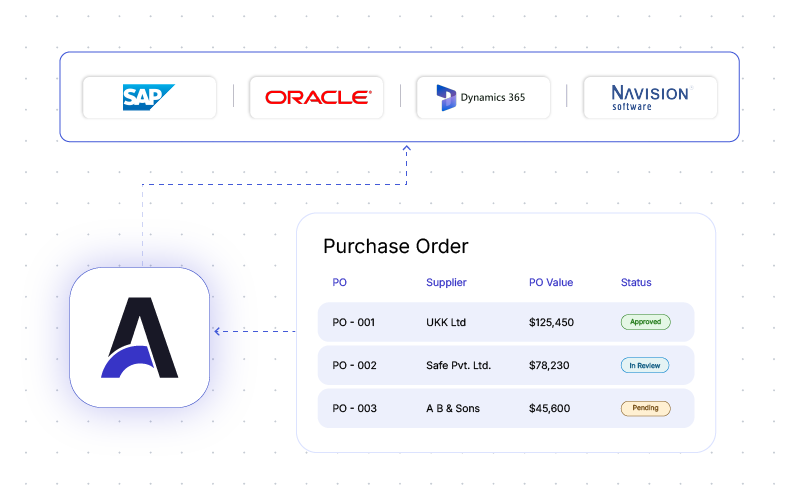
SAFAL's procurement orchestration platform connects natively with SAP, Microsoft Dynamics, Oracle, and Navision - extending procurement across sourcing, purchase orders, and invoicing without replacing or customizing the ERP your organization already depends on. Integration is bi-directional, built for enterprise scale, and proven across multi-entity deployments.






Why Enterprise Procurement Needs More Than an ERP System
Enterprises running SAP, Oracle, Microsoft Dynamics, or Navision have invested years in building financial control and a single system of record. But procurement teams working inside standard ERP environments can still leave procurement teams managing complex sourcing, supplier collaboration, approvals and negotiations across additional modules, spreadsheets, email or disconnected workflows. Sourcing, comparison, and negotiation typically happen in spreadsheets and email, invisible to the ERP until a purchase order is finally keyed in.
The gap widens with every year of customization. Custom code added to the ERP core to patch procurement workarounds becomes a liability during upgrades, and under SAP's clean core mandate for S/4HANA, every custom object inside the digital core adds risk and cost to migration. IT is left resisting yet another point solution that demands separate logins, duplicate master data, and manual reconciliation between systems.
What is ERP Integration for Procurement?
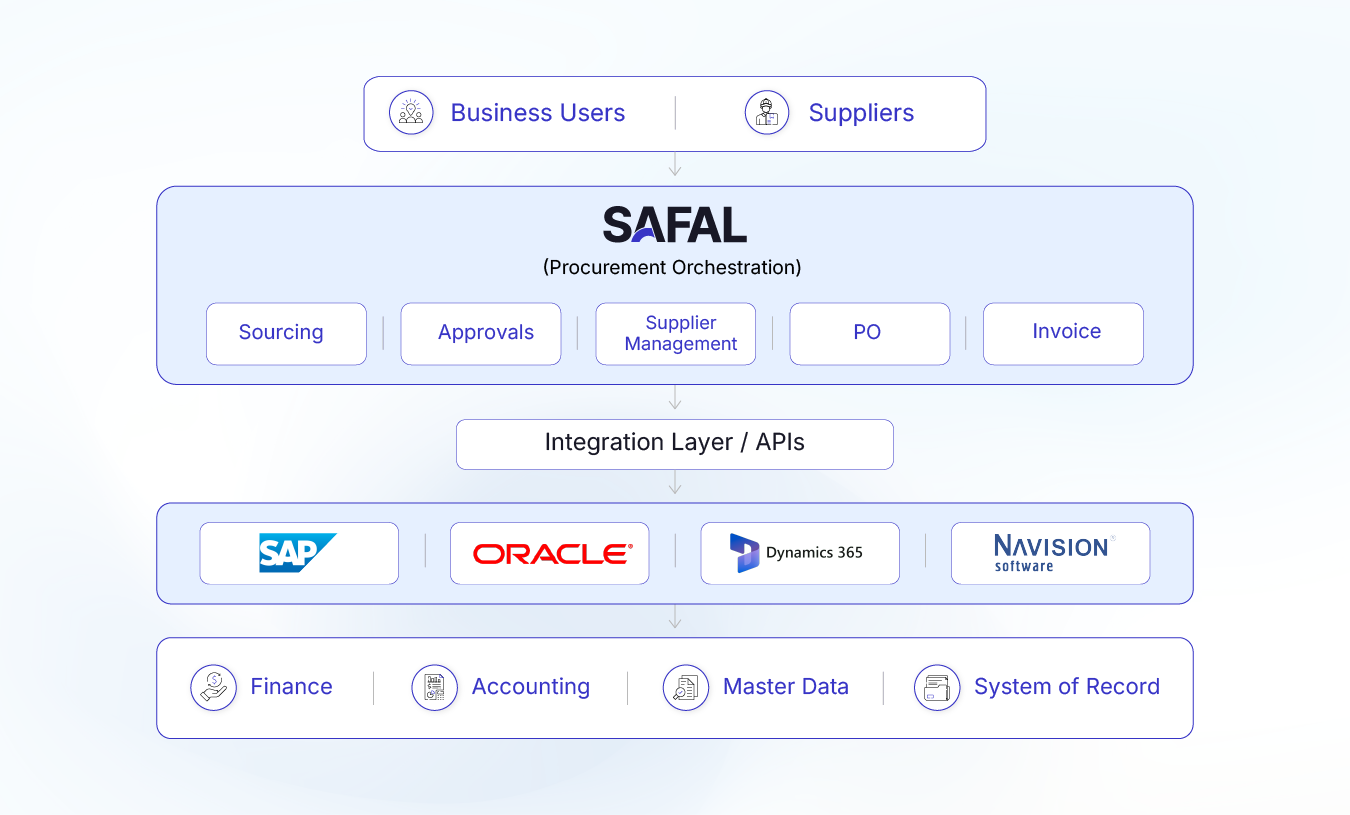
ERP integration for procurement is the bi-directional connection between a procurement platform and the ERP system of record, allowing procurement processes - sourcing, requisitions, purchase orders, and invoicing - to run outside the ERP while transactional and financial data stays synchronized inside it.
Within SAFAL's architecture, the ERP remains the system of record for finance, compliance, and reporting, while SAFAL operates as the system of orchestration - extending procurement capability around the ERP rather than replacing it:




How SAFAL ERP Integration Works?

Connect
- Supports on-premise, cloud, and hybrid ERP deployments
- Connector configured per ERP instance and legal entity
- Active Directory integration for centralized authentication
- No modification to ERP core code or configuration

Map
- Purchase order numbers, supplier IDs, and GL codes aligned across systems
- Cost center and entity structures mapped for multi-entity organizations
- Field mapping configured once per ERP instance, not per transaction
- Validation rules applied before data moves in either direction

Synchronize Master Data
- Supplier master records kept current across both systems
- Contracted pricing and item catalogs reflected in real time
- Scheduled or real-time sync depending on data volume
- Duplicate and conflicting records flagged before they enter the ERP

Orchestrate Transactions
- Requisitions, approvals, and sourcing managed in SAFAL
- Approved purchase orders posted directly into the ERP
- GRN and invoice data pulled from the ERP for matching
- The ERP remains the system of record for every posted transaction

Reconcile and Audit
- Exception alerts for mismatched or delayed postings
- Continuous reconciliation instead of month-end catch-up
- Full audit trail across every connected ERP instance
- Role-based access controls on every integration point
Supported ERP Platforms

SAP RISE
- Native connectivity to SAP ECC 6.0 and SAP S/4HANA, cloud or on-premise
- Bi-directional sync using released APIs - no custom code inside the SAP core
- Aligned with clean core principles for organizations migrating to S/4HANA
- Proven at multi-entity scale, including automated PR creation, delegation-of-authority approvals, and PO posting across multiple SAP entities
Microsoft Dynamics
- Integration with Dynamics 365 Finance and Supply Chain Management
- Real-time synchronization of purchase orders, receipts, and supplier master data
- Connectors adapt to entity-specific chart of accounts and approval hierarchies
- Supports both cloud and hybrid Dynamics deployments
Oracle (E-Business Suite and Fusion Cloud)
- Bi-directional integration with Oracle E-Business Suite and Oracle Fusion Cloud
- Contract awards, reverse and forward auction outcomes, and PO data post directly into Oracle
- Proven on complex, multi-stakeholder contracting workflows, including post-RFP contract creation with full Oracle integration for financial control
- Configurable for project-based and multi-entity Oracle landscapes
Navision (Microsoft Dynamics NAV)
- Dedicated connectors for legacy and current Navision environments
- Supplier master, PR, PO, and invoice data synchronized without disrupting existing NAV configuration
- Suited to single-entity and multi-entity organizations still running Navision alongside newer cloud systems
- Provides a stable integration layer for organizations planning a future ERP migration
Key Capabilities






Benefits for Enterprise Procurement Teams

No ERP Replacement Required

Reduced Reconciliation Effort

Consistent Data Across Entities

Faster Time to
Value

Supports a Clean Core Approach

Single Source of Financial Truth
Why SAFAL ERP Integration
- Dedicated connectors for SAP RISE, Oracle, Microsoft Dynamics, and Navision - not generic middleware - ensuring accurate data alignment
- Bi-directional architecture built on Web Services and APIs, operating without modifying ERP core code, ensuring long-term upgrade stability
- Provides full accountability with tamper-proof records and controlled access across every integrated transaction
- Phased implementation delivers a live ERP connection in weeks, not months - Anti-Big Bang by design
- ISO 27001 certified information security practices governing every integration
- Active Directory integration for centralized authentication across SAFAL and the connected ERP
- Proven at enterprise and multi-entity scale across India and the GCC
Use Cases

Multi-Entity Manufacturing on SAP
EPC Contracting
on Oracle

Textile and Process Manufacturing on SAP

Organizations Migrating to S/4HANA

Legacy Navision Environments
See How SAFAL Integrates With Your Existing ERP Environment
See how procurement workflows, master data and transactions can move between SAFAL and your SAP, Oracle, Dynamics or Navision environment while your ERP remains the system of record.

If you’re ready to unlock efficiency, savings, and confidence in your procurement process, SAFAL is the partner you’ve been waiting for.
TKIL Industries Pvt Ltd.
(formerly thyssenkrupp Industries India Pvt Ltd.)