































AI has become a standard part of the enterprise procurement technology conversation.. Spend analytics has AI. Sourcing has AI. Invoice matching has AI. Supplier risk scoring has AI. At this point, asking whether a procurement platform has AI is close to asking whether it has a database. The more useful comparison is no longer simply which AI features a platform offers, but what decisions those capabilities can influence, what actions they can take, and how those actions are governed.
The more important question is no longer only what AI can do, but what decisions it influences, how much authority it is given, and how those decisions remain governed and accountable. The principle is simple: AI should increase decision quality before it increases decision autonomy. This article explores what that means for human oversight, accountability and decision authority across procurement workflows.
Key Takeaways
What Is AI in Procurement?
AI in procurement covers several genuinely different technologies, often described with the same word. Embedded machine learning has quietly run spend classification, demand forecasting and anomaly detection for years. Generative AI drafts RFx documents, summarizes supplier responses and writes contract clauses from a prompt. Agentic AI goes further, chaining steps together and taking action, raising a purchase order, routing an approval, contacting a supplier, with limited or no human input at each step.
These are not interchangeable. A drafting tool that produces a document for human review carries a very different risk profile than an agent that submits a purchase order on its own. Most market conversation still treats them as one category called "AI," which is why the feature conversation has become unproductive: it compares the presence of AI rather than the decision authority AI has actually been given.
Why the Feature Conversation Has Hit a Ceiling
On a feature comparison slide, procurement vendors now look nearly identical: AI powered sourcing recommendations, AI powered spend insights, AI powered supplier scoring. Feature lists increasingly overlap across procurement platforms, particularly around spend analysis, sourcing assistance, document generation, supplier insights and anomaly detection. The more meaningful distinction is how those capabilities operate inside enterprise workflows and governance controls.
What genuinely differs between platforms is not whether AI exists, but how its authority is bounded, how its reasoning is exposed, and what happens when it is wrong. A platform that can explain why it flagged a supplier, route the flag to the right approver, and log the full decision trail is solving a different problem than one that simply displays a confident sounding recommendation. That difference rarely shows up on a feature list, and it is the gap this article is about.
The Real Question: Who Is Accountable for an AI Procurement Decision
In conventional procurement software, accountability is straightforward. A person raises a requisition, a person approves it, a person releases payment. If something goes wrong, the audit trail points to a name. Agentic AI disrupts that chain. When an agent interprets a situation and acts without a human explicitly directing that specific step, the action was not a direct execution of an instruction, it was an inference, and organizations often discover, only after something has gone wrong, that they never decided in advance who owns that inference.
AI does not eliminate organizational accountability. Enterprises still need clearly defined human roles and governance structures around AI-assisted or AI-executed decisions. Depending on the decision, accountability may involve procurement leadership, category or process owners, IT or AI governance functions, and the individuals authorized to review or approve material actions. The important point is that ownership, oversight and escalation are defined before decision authority is expanded.
What Does Effective Human Oversight in Procurement AI Require?
The most widely used reference point is the NIST AI Risk Management Framework, a voluntary framework published by the US National Institute of Standards and Technology, organized around four functions: Govern, Map, Measure and Manage. Its Govern function is most relevant here, requiring organizations to define roles and accountability structures before deployment, not a general commitment to "keeping a human in the loop."
- A named owner. Every AI capable workflow needs a specific accountable role, not a vague reference to "the procurement team."
- Defined authority boundaries. What value, category and risk thresholds can the AI act within, and at what point does a decision require human approval first.
- Explainability. The system should show what data informed a recommendation and why, not just present a confident output with no visible reasoning.
- An audit trail. Every AI assisted or AI executed action should be logged in a way that can be reconstructed later, for internal review and external audit.
- An override mechanism. Someone with the authority and the practical ability to pause, reverse or override an AI action, not just a theoretical right to do so.
The AI Decision Authority Spectrum
These elements are easiest to apply once decision authority is treated as a spectrum rather than a binary choice between manual and automated. This extends the same maturity thinking used elsewhere in enterprise procurement, where progress moves in stages rather than leaps, applied specifically to how much authority AI is given over a decision.
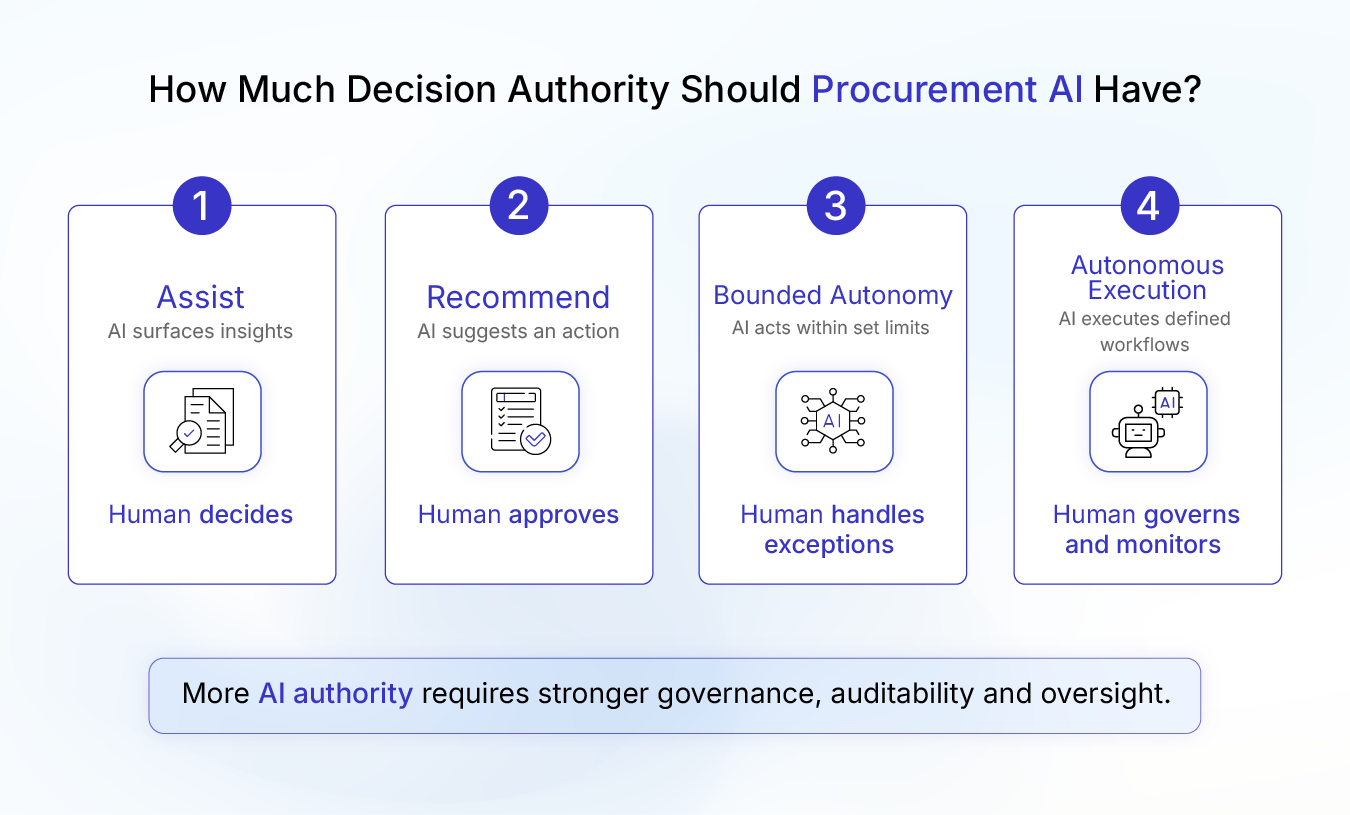
Five Questions Before Expanding AI Decision Authority
Before moving a workflow from Recommend to Bounded Autonomy, a small set of questions is worth answering honestly.
- Is the data feeding this decision clean and consistent enough to trust, or does it vary in quality across ERP instances, entities or suppliers.
- Can the system explain, in terms a non technical reviewer understands, why it reached a specific recommendation.
- Is there a named individual both authorized and practically able to review or override the action before or shortly after it occurs.
- What is the cost of being wrong, and is that cost easily reversible, such as a delayed purchase order, or hard to reverse, such as a released payment.
- Is the audit trail complete enough to reconstruct what happened if a regulator, auditor or internal investigation asks.
Granting autonomy based on vendor confidence rather than organizational readiness is a well documented failure pattern: Gartner projects more than 40% of agentic AI projects will be cancelled by the end of 2027, most often because the organization could not govern the autonomy it had granted.
Where Accountability Breaks Down in Procurement AI
Treating a recommendation as if it were an approval. When an AI suggested award quietly becomes the actual award because no one explicitly reviewed it, the organization has drifted from Recommend to Bounded Autonomy without deciding to.
No single owner for a multi step action. When an agent chains actions across systems, sourcing, approval routing, purchase order creation, and no individual owns the full sequence, responsibility becomes diffuse exactly when it needs to be clearest.
Opaque reasoning. A recommendation with no visible rationale limits the reviewer's ability to meaningfully evaluate the recommendation, increasing the risk that it is accepted or rejected without sufficient context.
An override that exists on paper only. A named approver with no realistic time or authority to intervene before an action executes provides after the fact awareness, not oversight.
Governance applied to the organization, not the workflow. A single company wide AI policy rarely fits every decision. A policy written for routine catalog purchasing is usually the wrong policy for supplier awards in a regulated category.
Not Every Procurement Decision Deserves the Same Level of Autonomy
The right decision authority level shifts by sector. In pharmaceuticals and chemicals, supplier qualification and compliance documentation carry regulatory weight that argues for keeping AI at Recommend rather than Bounded Autonomy, since an incorrect autonomous action is harder to justify to a regulator afterward. In EPC and infrastructure, project budget and milestone linked purchase orders benefit from explainability more than speed, since a wrong autonomous action against a fixed budget is costly to unwind. In manufacturing, high volume, low value direct material replenishment against pre negotiated contracts is often the most defensible place to extend Bounded Autonomy first, since the risk per transaction is low and the volume high.
SAFAL Insight
Most procurement AI marketing still describes capability: what the AI can find, draft, score or predict. Very little of it describes authority: how much of the actual decision the AI has been handed, and what happens when it gets that decision wrong. That is the gap this article has tried to close.
This extends a distinction already made earlier in this series. Automation executes predefined activity. Intelligence helps make a decision better informed. Governance defines the boundaries within which that decision can occur, while accountability establishes who remains responsible as AI authority expands. The principle is simple: AI should increase decision quality before it increases decision autonomy.
Where SAFAL Fits
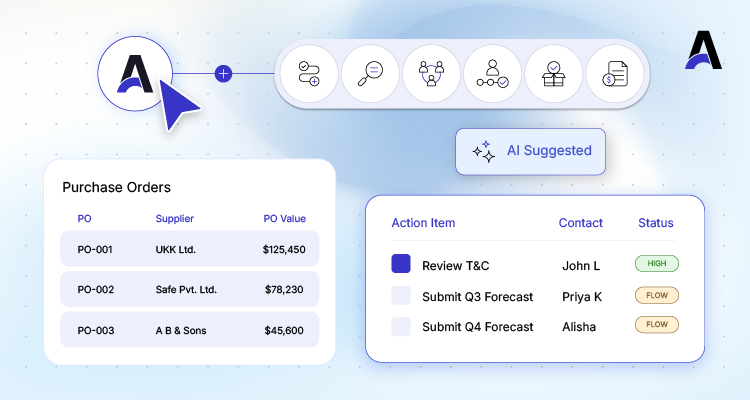
SAFAL treats AI as a participant in a governed workflow, not a replacement for one. Every AI generated recommendation, a flagged supplier risk, a suggested sourcing action, a spend anomaly, is attached to the policy, approval authority and audit context it needs to be reviewed properly, coordinated through procurement orchestration around the ERP the enterprise already runs. Recommendations do not silently become approvals. They route to a named owner, carry visible reasoning, and leave a traceable record of what was decided and by whom.
That structure is what allows decision authority to expand deliberately rather than by accident. As confidence in a specific workflow grows, workflow automation and spend analytics can move a well bounded, low risk transaction type from Recommend toward Bounded Autonomy without losing the audit trail or the override mechanism that oversight depends on.
Conclusion
AI in procurement is no longer a differentiator on its own, and comparing vendors by feature list will keep producing decisions that look identical on paper and perform very differently in production. The distinction that actually matters is whether an organization can say precisely who is accountable for each AI assisted decision, show the reasoning behind it, and intervene before it causes harm.
The practical next step is not adopting more AI. It is assigning an honest decision authority level, Assist, Recommend, or Bounded Autonomy, to each procurement workflow individually, and being clear eyed about which ones are not ready to move past Recommend yet.
Frequently Asked Questions

Mohammad Ali Holda
Mohammad Ali Holda has built SAFAL's enterprise client portfolio across India and the GCC through a consultative, environment-first approach.