





























Most procurement software evaluations start with a feature list and end with the vendor whose demo looked the most polished. But a strong demo and a comprehensive feature checklist do not necessarily predict whether the platform will fit the enterprise's operating environment after implementation.
This guide sets out a practical framework for choosing enterprise procurement software: how to frame the decision so both CPO and CIO priorities are represented, eight criteria to score every vendor against, and the mistakes that most often turn a promising selection process into expensive shelfware.
Key Takeaways
Why Feature-First Procurement Software Selection Fails
Every enterprise procurement platform on the market today can plausibly claim spending analytics, strategic sourcing, contract management, supplier portals and some form of AI. On a feature comparison slide, the differences between vendors compress almost nothing. That similarity is precisely the problem: it pushes buying committees toward the vendor with the best demo or the most aggressive discount, rather than the platform best suited to the enterprise’s actual environment.
The criteria that actually predict whether an implementation succeeds rarely appear on that slide: how deeply the platform integrates with the specific ERP already in place, how the platform behaves under the enterprise’s real approval structure rather than a demo scenario, what the total cost looks like once implementation, configuration and change management are included, and whether suppliers will actually adopt it. A structured, jointly owned evaluation framework is what surfaces these before the contract is signed rather than after.
Fit-to-Process vs Force-to-Platform
The most useful lens for any enterprise procurement software decision is a simple question: does this platform adapt to how the business already runs procurement, or does the business have to redesign its processes to fit the platform?
Force-to-platform software ships with a fixed, standardized workflow and expects the enterprise to conform to it. That can work for a single-entity business with simple approval chains. It becomes a liability fast in multi-entity organizations, where delegation of authority, regional policy and category-specific approval rules genuinely differ across business units, and a rigid platform either blocks legitimate variation or gets bypassed through the same email and spreadsheet workarounds it was bought to eliminate.
Fit-to-Process does not mean reproducing every legacy workflow or exception. It means supporting the enterprise's legitimate operating requirements such as entity structures, approval authority, category rules, and ERP environment without forcing unnecessary standardization or excessive customization. That distinction should sit above every individual feature on the evaluation checklist, because it determines whether the other eight criteria in this framework are even evaluated fairly, on the platform’s ability to fit the business, not the business’s ability to fit the platform.
Aligning CPO and CIO Priorities
Procurement software selection usually gets scoped as a CPO decision with IT sign-off, or as a CIO-led technology decision with procurement input. Both framings create blind spots. The CPO is focused on sourcing depth, supplier experience and process fit; the CIO is focused on integration risk, security and long-term maintainability. A platform that scores well on one set of priorities and poorly on the other tends to underperform regardless of which side won the argument.
| Priority Area | CPO's Primary Concern | CIO's Primary Concern |
|---|---|---|
| ERP and systems | Does data flow accurately into existing reporting? | Does integration require custom code or ERP core changes? |
| AI and automation | Does it reduce manual sourcing and approval work? | Is the underlying data clean enough for AI to be reliable? |
| Scalability | Can it support new categories and entities as we grow? | Can it scale without a re-architecture or new licensing tier? |
| Governance | Does it preserve approval of authority and policy and governance control? | Is access control, audit trail and compliance enterprise-grade? |
| Cost | Does the pricing model support phased category rollout? | What is the true multi-year cost including integration and support? |
Scoring vendors against both columns for every criterion, rather than letting one function own the decision, is what turns this into a genuinely enterprise-grade evaluation.
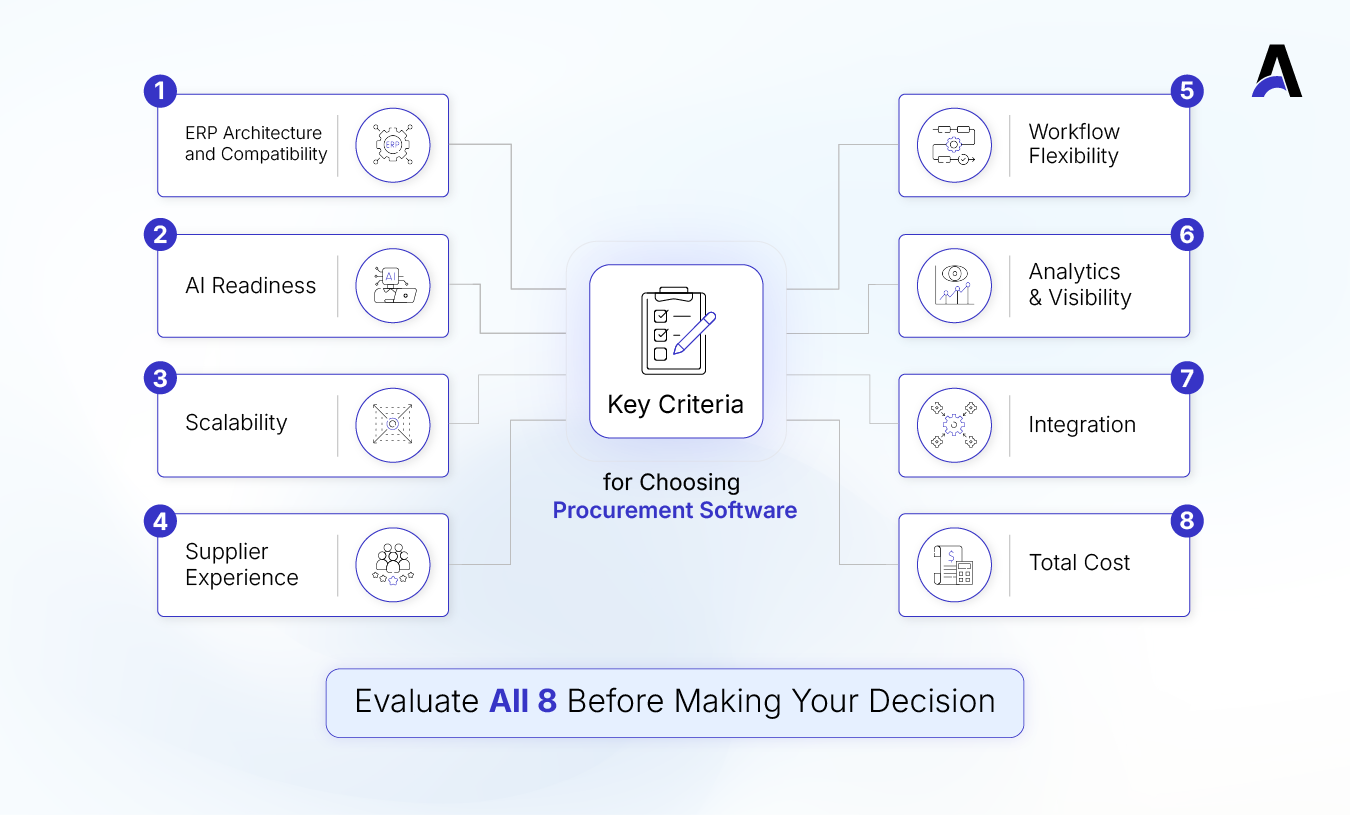
The 8-Criteria Enterprise Evaluation Framework
The following framework can be used directly as an RFP scorecard. Each criterion below includes what it measures, questions to put to every vendor, and which stakeholder should weigh it most heavily.
| Criterion | What It Measures | Key Question to Ask | Primary Owner |
|---|---|---|---|
| ERP Compatibility | Depth of native, bi-directional integration with the ERP already in place | Does this require custom development inside our ERP core, or is governed by API integration around it? | CIO |
| AI Readiness | Whether AI features work on real enterprise data or only on clean demo data | How does AI perform on our enterprise data, what decisions can it influence, and what governance and human controls apply to its recommendations or actions? | Both |
| Scalability | Ability to support more entities, categories and users without re-platforming | What happens to performance and pricing as we add three more business units? | CIO |
| Supplier Experience | How easily suppliers can onboard, respond to RFx and submit invoices | What is your average supplier onboarding time and self-service adoption rate? | CPO |
| Workflow Flexibility | Configurability of approval chains, delegation of authority and exceptions | Can we configure multi-entity approval rules without vendor development work? | CPO |
| Analytics and Visibility | Whether spend visibility is predictive or only historical reporting | Does the platform flag exceptions and risks before spending is committed, or only after? | Both |
| Integration Capability | Breadth of connections beyond the core ERP: finance, HR, banking, e-invoicing | Which of our other systems connect natively, and which requires middleware? | CIO |
| Total Cost of Ownership | Full multi-year cost: licensing, implementation, integration, training, support | What does year two look like once implementation costs fall? | CPO |
How to Score and Weight the Framework
Turn the table above into a working scorecard by scoring each vendor from 1 to 5 on every criterion, then applying a weight that reflects the enterprise’s actual priorities rather than a generic default.
- Score each vendor 1 (does not meet requirement) to 5 (exceeds requirement) against every criterion, based on evidence, not vendor claims: a proof-of-concept, a reference call, or a documented integration case.
- Weight ERP Compatibility and Total Cost of Ownership are more heavily for organizations with complex, multi-instance ERP environments, since integration risk and hidden cost compounds are fastest there.
- Weight Supplier Experience is more heavily for organizations with large, fragmented supplier networks, since low adoption quietly undermines every other stage of the process.
- Score AI Readiness against your own data, not the vendor’s demo data: ask what happens to the AI features when spending data is messy, categorized inconsistently, or split across two ERP instances.
- Revisit the weighting with both CPO and CIO in the room before scoring begins, not after, so the framework reflects a shared decision rather than a negotiated compromise.
Common Procurement Software Selection Mistakes
Matching features instead of testing fits. A checklist match on paper does not confirm the platform works inside the enterprise’s actual approval structure, only that the vendor claims the capability exists.
Evaluating only the demo scenario. Vendor demos are built around a clean, simple workflow. Ask to see the platform handle a multi-entity approval exception or a three-way match of discrepancy, the situations that actually determine day-to-day usability.
Underestimating the total cost of ownership. License fees are the most visible cost. Implementation, integration, data migration, training, and ongoing configuration support are frequently the larger ones and rarely appear in the initial quote.
Treating ERP integration as a checkbox. "Integrates with SAP" can mean anything from a governed, bi-directional API to a one-way nightly data export. The difference determines whether procurement and finance ever see the same numbers in real time.
Ignoring supplier adoption. A platform that supplier finds it difficult to use gets bypassed through phone calls and email, quietly recreating the disconnected process the software was bought to eliminate.
Selecting for AI capability without checking AI readiness. An impressive AI demo built on clean sample data says little about how those features will perform on the enterprise’s actual, often messy, multi-source spend data.
Industry Considerations
The relative weight of each criterion shifts by sector. EPC and infrastructure buyers should weight workflow flexibility heavily, since bill-of-quantities structures and multi-stage bid evaluation rarely fit a standardized approval chain. Oil and gas and chemicals buyers should weight supplier experience and governance together, since supplier qualification and HSE documentation both depend on high supplier engagement with the platform. Manufacturing buyers evaluating multi-plant procurement should weight scalability and ERP compatibility highest, since direct material sourcing typically runs closest to the ERP and is least tolerant of integration gaps.
SAFAL Insight
Most procurement software RFPs are built around what a platform can do in isolation. The more useful question is what a platform can do inside the enterprise’s actual environment: its ERP, its approval structure, its supplier base, its industry-specific compliance requirements.
That is the practical meaning behind evaluating fit before features. A platform that scores lower on a generic feature checklist but higher on ERP compatibility, workflow flexibility and supplier adoption will typically outperform a feature-richer platform that has to be worked around six months into implementation. The eight-criteria framework above is designed to surface that difference before the contract is signed, not after.
Where SAFAL Fits
SAFAL is built around a Fit-to-Process approach to enterprise procurement. This means supporting legitimate differences in approval structures, procurement policies, entity requirements and ERP environments without forcing every part of the organization into a rigid process or relying on excessive customization to accommodate every exception.
SAFAL works alongside existing ERP environments to connect sourcing, suppliers, approvals and purchasing within a governed procurement flow. The objective is not to replace the enterprise systems already in place, but to strengthen how procurement operates around them through configurable processes, connected execution and better visibility into the decisions and exceptions that require attention.
For enterprises evaluating procurement technology, the same principle should apply regardless of vendor: look beyond whether a platform has the required features and evaluate how well those capabilities will work within your actual operating environment.
Conclusion
Choosing procurement software is not a features exercise. It is a fit exercise, and the organizations that get it right are the ones that build a shared, weighted scorecard before the first vendor demo rather than the shortlist is already set.
The eight criteria in this framework, scored jointly by CPO and CIO and weighted to the enterprise’s actual environment, will not guarantee a perfect decision. They provide a more disciplined basis for identifying fit, risk and trade-offs before a platform decision is made.
See how SAFAL scores against this framework for your ERP environment, or book a demo to walk through the scorecard with the SAFAL team.
Frequently Asked Questions

Mohammad Ali Holda
Mohammad Ali Holda has built SAFAL's enterprise client portfolio across India and the GCC through a consultative, environment-first approach.